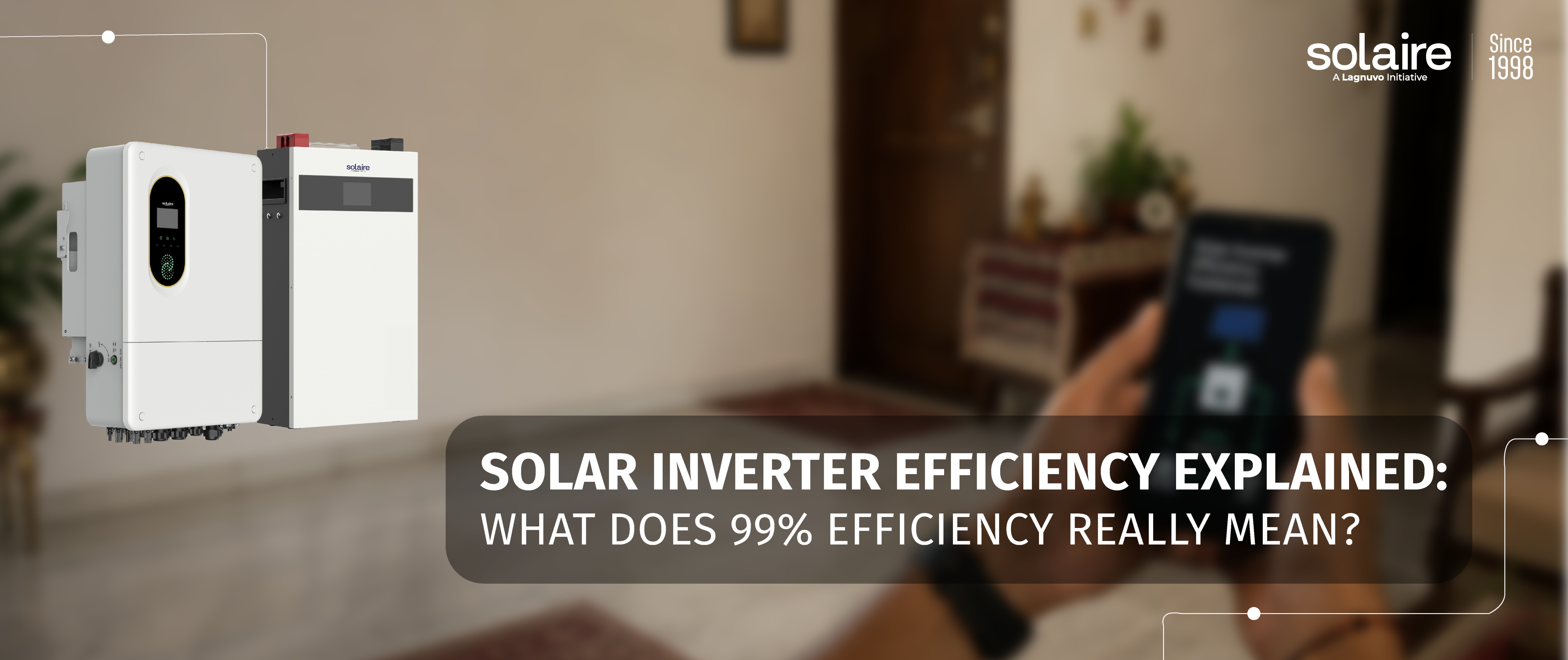
Solar Inverter Efficiency Explained: What Does 99% Efficiency Really Mean?
Solar Inverter Efficiency Explained: What Does 99% Efficiency Really Mean?
When people compare solar inverters, one number often stands out immediately: efficiency. A specification like 98% or 99% sounds impressive, but many buyers still wonder what that figure really means in practice. The answer matters because inverter efficiency directly affects how much of your solar power becomes usable electricity.
A solar inverter's job is to convert DC electricity from your panels into AC electricity for appliances, buildings, or the grid. That process is called energy conversion, and it is never perfectly lossless. Some amount of power is always lost as heat during conversion.
So, when a manufacturer says an inverter is 99% efficient, it means the unit can convert 99% of the DC power it receives into usable AC power, while about 1% is lost during the process. If 1000 W of DC enters the inverter, about 990 W becomes usable AC output and around 10 W is lost.
This is why inverter efficiency is not just a lab number. It has a direct effect on daily solar output, long-term savings, and the overall value of a solar project. Higher efficiency means more of the energy generated by your panels is preserved and delivered where it is needed.
Solaire's own product messaging reflects this performance-led positioning, with brand and product materials highlighting high-efficiency inverter design, strong reliability, and smart energy compatibility.
What efficiency actually measures
At its core, inverter efficiency tells you how well the inverter performs the task of energy conversion. The standard formula is:
Efficiency = (AC Output Power ÷ DC Input Power) × 100
This means the inverter is judged by how much usable output it preserves from the incoming solar energy. If an inverter receives 1000 W from the solar array and delivers 980 W as AC output, its efficiency is 98%.
This percentage matters because a solar system produces electricity over many years. Small differences in energy conversion efficiency can accumulate into meaningful differences in total usable energy over time.
Why 99% sounds small but matters a lot?
At first glance, the difference between 98% and 99% may seem minor. But in solar energy, even a 1% difference can be significant when it is applied across thousands of operating hours and large amounts of generation. One industry example shows that increasing fleet-wide inverter conversion efficiency from 98% to 99% can translate into a very large difference in total AC output at scale.
For an individual system, the same principle still applies, just on a smaller scale. Better inverter efficiency means less power wasted as heat and more power contributing to your actual solar output.
This is why high-efficiency inverters are often seen as part of smarter, more innovative solar solutions. They do not just look better on paper; they help improve how effectively a system performs in the real world.
Peak efficiency vs real-world efficiency
One of the most important things to understand is that a "99% efficiency" claim is often a peak figure, not the number the inverter will maintain every minute of every day. Real performance varies depending on temperature, load conditions, ventilation, and operating environment.
That means buyers should look beyond the headline number and understand how the inverter behaves in actual operating conditions. Modern high-quality inverters usually operate in the 95% to 98% range in everyday use, while premium systems can peak above that under ideal conditions.
This is also why good engineering matters. Better cooling, smarter switching design, and improved internal components can reduce losses and support more stable energy conversion across different load conditions.
How efficiency affects solar output and ROI
The link between inverter efficiency and solar output is straightforward: the better the inverter converts power, the more usable electricity your system can deliver. Over time, this can support better self-consumption, stronger bill savings, and improved return on investment.
In practical terms, a more efficient inverter helps the rest of the solar system work harder. You have already paid for the panels to produce the electricity. The inverter's role is to preserve as much of that value as possible during energy conversion.
This is particularly important in projects where energy performance is closely watched, such as commercial rooftops, higher-consumption homes, and systems designed for smart battery integration. That is one reason efficiency continues to be a central metric in innovative solar solutions.
What a good efficiency figure looks like today
Industry guidance suggests that modern solar inverters should generally deliver at least around 95% efficiency, with high-quality models often operating in the 97% to 98% range and some premium models reporting peak efficiencies around or above 99%.
Solaire's own public-facing product and social content repeatedly highlights 98% efficiency in its hybrid and storage-related messaging, which places the brand in the high-efficiency category that many buyers now expect from modern inverter systems.
That does not mean every buyer should chase the highest possible number in isolation. Efficiency should be considered together with warranty, compatibility, service support, operating conditions, and the overall system design.
Why it matters in inverter selection.
A high-efficiency inverter helps reduce conversion loss, improve usable solar output, and strengthen long-term value. But the bigger takeaway is that inverter efficiency helps reveal how seriously a manufacturer approaches product quality and system performance.
In modern solar projects, this is part of a broader shift toward innovative solar solutions that combine efficient hardware, smarter monitoring, stronger battery integration, and better real-world reliability.
That is why 99% efficiency should not be viewed as just a marketing badge. It should be understood as a signpost in a bigger conversation about better energy conversion, lower losses, and more effective solar system design. For users comparing categories and applications, Solaire's solar inverter portfolio offers a useful starting point for understanding how efficiency fits into overall system value.