Future Trends in Solar Inverter Technology for 2026 and Beyond
Future Trends in Solar Inverter Technology for 2026 and Beyond
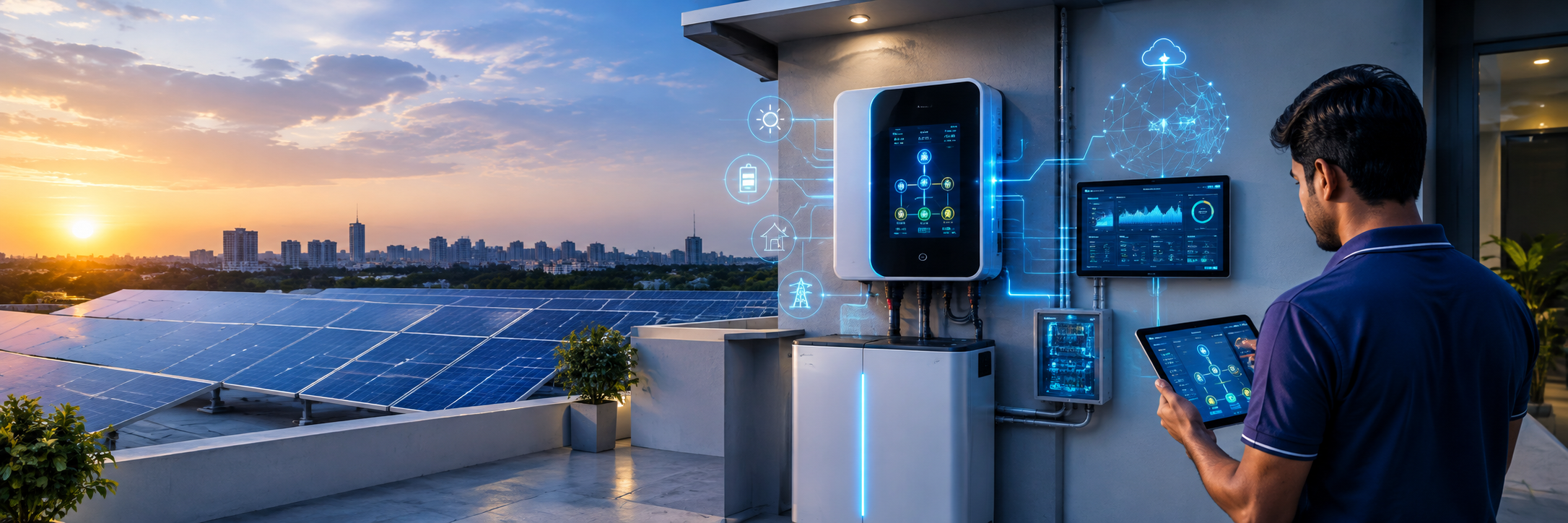
Solar inverters are becoming intelligent energy-control systems rather than simple devices that convert solar electricity from DC to AC. From AI monitoring and storage-ready hybrid designs to grid-forming capability and stronger cyber protection, the next generation of inverter technology will shape how India generates, stores, manages, and stabilises solar power.
For homeowners, businesses, EPC companies, and utility developers, the solar future will be defined not only by how many panels are installed, but by how intelligently inverter systems respond to changing energy demand, weather, storage levels, and grid conditions.
Inverters are becoming energy brains
For decades, the central task of a solar inverter was clear: convert the direct-current electricity produced by solar panels into alternating-current electricity that a home, business, factory, or utility grid can use.
That conversion role remains fundamental. But it is no longer the full story.
As solar adoption increases, inverter systems must do more than maximise power conversion. They must manage changing solar generation, coordinate batteries, respond to grid signals, protect connected equipment, provide operational data, and, at larger scales, help maintain voltage and frequency stability.
This is why the modern smart inverter is increasingly described as an active energy-management device.
Technology advances are accelerating the adoption of high-efficiency string, hybrid, and microinverters that are storage-ready, digitally connected, and capable of supporting smarter grid operations. Cloud platforms are also making real-time performance tracking and faster fault identification more accessible across residential, commercial, and utility-scale solar projects.
For India, where rooftop solar, commercial and industrial solar, agricultural solar, battery storage, smart meters, and large renewable-energy projects are all expanding, this evolution is especially important.
The future of solar is not simply solar generation. It is solar generation combined with storage, intelligence, communication, flexibility, and resilience.
1. Smart inverters will become standard
A smart inverter does more than convert electricity. It can communicate with the grid, respond to operating conditions, manage export, support voltage and frequency functions, coordinate with battery storage, and provide detailed system data through connected monitoring platforms.
Traditional inverters have generally operated by following an existing grid signal. The next generation increasingly needs to interact with that grid in a more active and controlled way.
This shift is being driven by three broad developments:
- More distributed solar connected to local electricity networks
- Greater need to manage voltage fluctuations and variable generation
- Higher customer demand for monitoring, backup, storage, and energy control
As more households and businesses install rooftop solar, the grid receives energy from thousands of decentralised systems rather than only a small number of large power plants. That creates new opportunities for cleaner energy, but it also creates operational challenges.
At certain times of day, especially in areas with high rooftop-solar penetration, local solar generation can exceed nearby demand. At other times, such as evening hours, solar generation drops while electricity demand rises. Smart inverter functions can help systems respond more smoothly to these conditions.
India’s inverter market is already moving toward IoT-enabled products that support real-time tracking, remote diagnostics, predictive maintenance, and cloud- or app-based visibility. Market analysis also identifies hybrid inverter systems, which combine solar conversion and battery-storage capability, as a growing part of the residential and commercial market.
For customers, this means that inverter selection should increasingly consider digital capability, data access, monitoring reliability, future battery compatibility, and grid-support features, not only the inverter’s rated kW capacity.
2. AI monitoring will move from alerts to prediction
The next major change is the integration of artificial intelligence into solar monitoring and maintenance.
Most solar systems can already report basic information such as daily energy generation, current power output, battery status, grid availability, and fault codes. That information is useful, but it still requires users or service teams to interpret what has happened.
AI monitoring aims to go further. Instead of only reporting a fault after it occurs, an AI-enabled system can analyse operating data to identify patterns that may indicate an emerging problem.
These data points can include:
- Inverter temperature trends
- Voltage and current behaviour
- Energy yield compared with expected generation
- Battery charging and discharge patterns
- Grid events and interruptions
- Repeated fault codes
- Communication loss
- String-level or MPPT-level performance variation
- Weather and irradiance conditions
Advanced analytics and machine-learning models can compare live data against expected operating patterns. If the system notices abnormal behaviour, such as repeated overheating, declining output from a particular string, unusual voltage movement, or a pattern associated with component stress, it can flag the issue earlier.
Industry analysis notes that AI-based predictive-maintenance tools can use real-time operating parameters, temperature trends, and energy-output data to identify anomalies before they result in equipment failures.
Why predictive maintenance matters
For a homeowner, early diagnosis may prevent a long period of unnoticed underperformance.
For an installer, AI-based insights can reduce time spent troubleshooting and allow service teams to prioritise visits to systems that need attention.
For a commercial solar operator, it can mean reduced downtime, better maintenance planning, and clearer visibility across multiple sites.
For utility-scale projects, predictive maintenance can support asset availability and help protect project economics over the life of the plant.
The goal is not to replace qualified technicians. It is to give them better data, earlier warnings, and a more focused view of where action is needed.
3. Hybrid solar and storage will expand rapidly
Solar power is strongest during the day. But electricity demand does not always follow sunlight.
Homes may need electricity in the evening. Businesses may face high-demand periods outside peak solar hours. Critical loads may need to continue during outages. Commercial facilities may want to reduce dependence on diesel generators. Grid operators may need more flexibility to manage changing supply and demand.
This is why hybrid solar inverters and battery energy storage systems are becoming central to the solar future.
A hybrid inverter can combine solar panels, batteries, grid electricity, and designated backup loads in one coordinated system. It can use solar energy for daytime consumption, charge batteries with surplus solar energy, supply selected circuits during grid outages, and help optimise when electricity is drawn from or exported to the grid.
Industry reporting identifies storage-ready inverter designs as increasingly important as net-metering arrangements evolve and grid constraints increase. It also highlights the rising relevance of solar-plus-storage systems across residential, commercial, and industrial applications.
What this means in practice
A homeowner might use solar power to run daytime appliances, store surplus electricity in an LFP battery, and use the battery later for lights, fans, Wi-Fi, refrigeration, and selected sockets.
A shop might use solar to reduce daytime energy costs, then use battery storage to keep billing systems, security, lighting, and refrigeration operating during an outage.
A commercial facility might use solar-plus-storage to reduce peak demand, support critical circuits, or lower generator runtime.
The key point is that the inverter becomes the decision-maker. It continuously coordinates where energy comes from and where it goes: solar array, battery, grid, or loads.
For buyers, the question is increasingly moving from “Do I need a solar inverter?” to “Do I need a solar inverter that is ready for storage, backup, and future energy management?”
4. Grid-forming inverter technology will gain importance
One of the most significant solar inverter innovations for the years ahead is the grid-forming inverter.
To understand why it matters, it helps to compare two approaches.
A conventional grid-following inverter needs an established grid signal. It detects the grid’s voltage and frequency and synchronises its output accordingly. This works well when the wider grid is strong and conventional generators provide the reference signal.
A grid-forming inverter is different. It can establish and regulate voltage and frequency itself. In practical terms, it can behave more like an active source of grid stability rather than only a device that follows the existing grid.
Grid-forming inverters are especially relevant in:
- Microgrids
- Remote or weak-grid locations
- Solar-plus-storage projects
- Islanded operation during grid outages
- High-renewable-energy power systems
- Large projects where system strength is a concern
The International Energy Agency identifies grid-forming inverters as a proven solution among cutting-edge energy technologies, while noting that they can reinforce system strength as synchronous generation declines in electricity systems with growing shares of inverter-based renewables.
Industry analysis similarly explains that grid-forming inverters can independently establish voltage and frequency, making them useful for weak grids, microgrids, and islanded operation.
Why this matters for India
India is adding renewable capacity across large solar parks, commercial facilities, agricultural applications, remote areas, and dense urban rooftop networks. As renewable-energy penetration increases, grid stability and flexibility will become more important considerations.
Grid-forming technology is unlikely to be a standard requirement for every small home rooftop system in the immediate future. However, it is likely to become increasingly relevant for battery-backed microgrids, commercial and industrial resilience projects, remote sites, grid-support applications, and utility-scale renewable installations.
In other words, grid-forming capability is not simply an advanced technical feature. It is a pathway toward operating reliable electricity systems with much higher shares of renewable energy.
5. Monitoring platforms will become more actionable
Solar monitoring has traditionally focused on basic dashboards: energy generated today, total lifetime generation, current power output, and inverter status.
Those functions will remain useful, but the future is more proactive and integrated.
Next-generation platforms will increasingly connect:
- Solar generation data
- Battery state of charge and health
- Building energy consumption
- Grid import and export
- Weather and irradiance data
- Load priorities
- Tariff schedules
- Service and fault information
- Multi-site performance data
This creates a more complete view of energy use.
Instead of seeing only that a solar system produced 20 kWh today, an owner may be able to understand how much solar was used directly, how much was stored, how much electricity was imported from the grid, which loads were responsible for peak consumption, and whether the system is performing within its expected range.
For commercial and industrial customers, this can support better energy decisions. For example, a facility may shift selected flexible loads to the middle of the day, when solar production is high, rather than operating them during expensive or grid-constrained periods.
AI monitoring is also expected to support automated fault classification, energy-yield optimisation, remote diagnostics, and more intelligent grid-interactive control.
The result will be a move from passive monitoring to active energy management.
6. Cybersecurity will become part of inverter design
As inverters become connected devices, they also become part of a digital energy network.
Remote monitoring, cloud connectivity, mobile applications, firmware updates, export control, and smart-grid communication can create meaningful advantages. But they also increase the importance of cybersecurity.
A connected inverter should be treated as critical energy infrastructure, even when it serves a single home or small business. Security considerations will increasingly include:
- Protected communication between inverter and monitoring platform
- Secure user access and account controls
- Regular firmware updates
- Strong authentication procedures
- Secure configuration during installation
- Controlled remote-service access
- Data protection and privacy
- Appropriate network design for commercial sites
This does not mean solar customers need to become cybersecurity experts. It means inverter manufacturers, installers, and asset owners should recognise that digital reliability is now part of energy reliability.
As solar technology becomes more connected, secure communications and maintainable software will become important criteria alongside conversion efficiency, warranty terms, IP rating, battery compatibility, and service support.
7. Higher efficiency will remain important, but it will not be enough
Conversion efficiency will always matter. Every unit of solar energy that is lost during conversion reduces overall system yield.
Future inverter designs will continue to pursue high efficiency through improved power electronics, thermal management, wider MPPT operating ranges, refined control software, and better component design.
However, efficiency alone is no longer enough to define a leading inverter.
A highly efficient inverter that cannot support batteries, provide useful monitoring, respond intelligently to grid conditions, detect faults early, or scale with future energy needs may not deliver the best lifetime value.
The next generation of inverter evaluation will include several dimensions:
| Selection factor | Why it matters beyond 2026 |
|---|---|
| Conversion efficiency | Supports higher solar yield from the installed array |
| MPPT capability | Helps manage differing solar-string conditions and roof layouts |
| Storage readiness | Allows solar energy to be shifted to evening use or backup |
| Smart inverter functions | Supports grid interaction, export management, and active energy control |
| AI monitoring | Helps identify abnormal patterns and support preventive maintenance |
| Grid-forming capability | Becomes more relevant for microgrids, storage and high-renewable systems |
| Connectivity options | Keeps operational data available across Wi-Fi, LAN or cellular networks |
| Cybersecurity | Protects connected energy assets and remote system access |
| Scalability | Helps customers add solar panels, batteries or loads as needs evolve |
| Service ecosystem | Supports long-term reliability through technical support and maintenance |
The best inverter will increasingly be the one that fits the broader energy strategy, not simply the one with the highest published efficiency number.
8. Inverters will support more decentralised energy systems
The solar future is becoming more distributed.
Instead of electricity flowing only from large central power stations to passive customers, millions of homes, businesses, electric vehicles, batteries, and solar systems are becoming active participants in the energy system.
This is often described as a distributed energy-resource model. In this model, the inverter is a critical interface between local energy resources and the wider grid.
A home with rooftop solar, battery storage, smart appliances, and an electric vehicle may eventually operate as a flexible energy node. A commercial facility may use solar and batteries to reduce demand during peak periods. A community or industrial park may use microgrids to improve local energy resilience.
Smart inverters will enable much of this transition by helping local systems generate, consume, store, export, or limit energy in a coordinated way.
The International Energy Agency reports that solar generation continued to rise strongly in the first half of 2026, with an estimated increase of more than 20%. As solar capacity grows, the need for intelligent power electronics and flexible system operation grows with it.
What buyers should do now
The solar-inverter market is advancing quickly, but customers do not need to wait for every future technology to become mainstream.
The practical approach is to select equipment that meets today’s needs while remaining prepared for likely changes.
When evaluating a solar inverter in 2026 and beyond, ask:
- Is the inverter suitable for the project’s current load and expected growth?
- Does it offer reliable monitoring and remote diagnostics?
- Is it compatible with battery storage, even if batteries are added later?
- Does it have the MPPT flexibility needed for the roof or solar-array layout?
- Can it support essential-load backup if resilience becomes a priority?
- What connectivity options are available: Wi-Fi, LAN, 4G, or other methods?
- How are firmware updates and cybersecurity handled?
- Does the manufacturer provide strong warranty, service, and technical support?
- For commercial or utility projects, are advanced grid-support or grid-forming functions relevant to the site?
A homeowner may prioritise hybrid readiness, monitoring, and essential-load backup. A business may need load management, storage integration, and multi-site visibility. A utility or microgrid developer may need advanced grid-support functions, robust diagnostics, and grid-forming capability.
The right answer depends on the application. But the common direction is clear: solar inverters are becoming more intelligent, connected, flexible, and essential to the energy system.
The solar future is intelligent
The most important future trend in solar inverter technology is not one component or one software feature. It is the convergence of power conversion, storage, intelligence, connectivity, and grid support.
A smart inverter will increasingly optimise energy in real time. AI monitoring will make maintenance more predictive. Hybrid designs will make solar useful beyond daylight hours. Grid-forming inverter technology will help support stable, renewable-rich electricity systems. Digital platforms will make performance visible. Stronger cybersecurity will protect connected assets.
For India’s solar future, these innovations can help make clean energy not only more affordable, but also more dependable, flexible, and capable of supporting a modern electricity network.