Solaire at RenewX 2026: Solar Inverters, Storage and Smart Monitoring for India’s Energy Future
Solaire at RenewX 2026: Solar Inverters, Storage and Smart Monitoring for India’s Energy Future
India’s solar transition needs complete solutions
India’s solar market is moving beyond a single question, “How many panels can a roof hold?” Homeowners, installers, EPC companies, commercial facilities, and large solar developers are now asking broader and more practical questions.
How can a rooftop system maximise self-consumption? How can a home keep essential loads running when the grid fails? How can a business monitor distributed solar assets across multiple locations? How can large solar plants maintain reliable, high-yield conversion under changing grid conditions?
These questions are why system design matters just as much as solar-panel capacity. A solar installation depends on the equipment that converts, manages, stores, communicates, and protects energy. At the centre of that system sits the inverter.
As a solar inverter company in India, Solaire brings together the technologies needed across the solar value chain: efficient on-grid inverters, intelligent hybrid inverters, scalable lithium energy-storage batteries, high-capacity utility inverters, and connectivity accessories for ongoing performance monitoring.
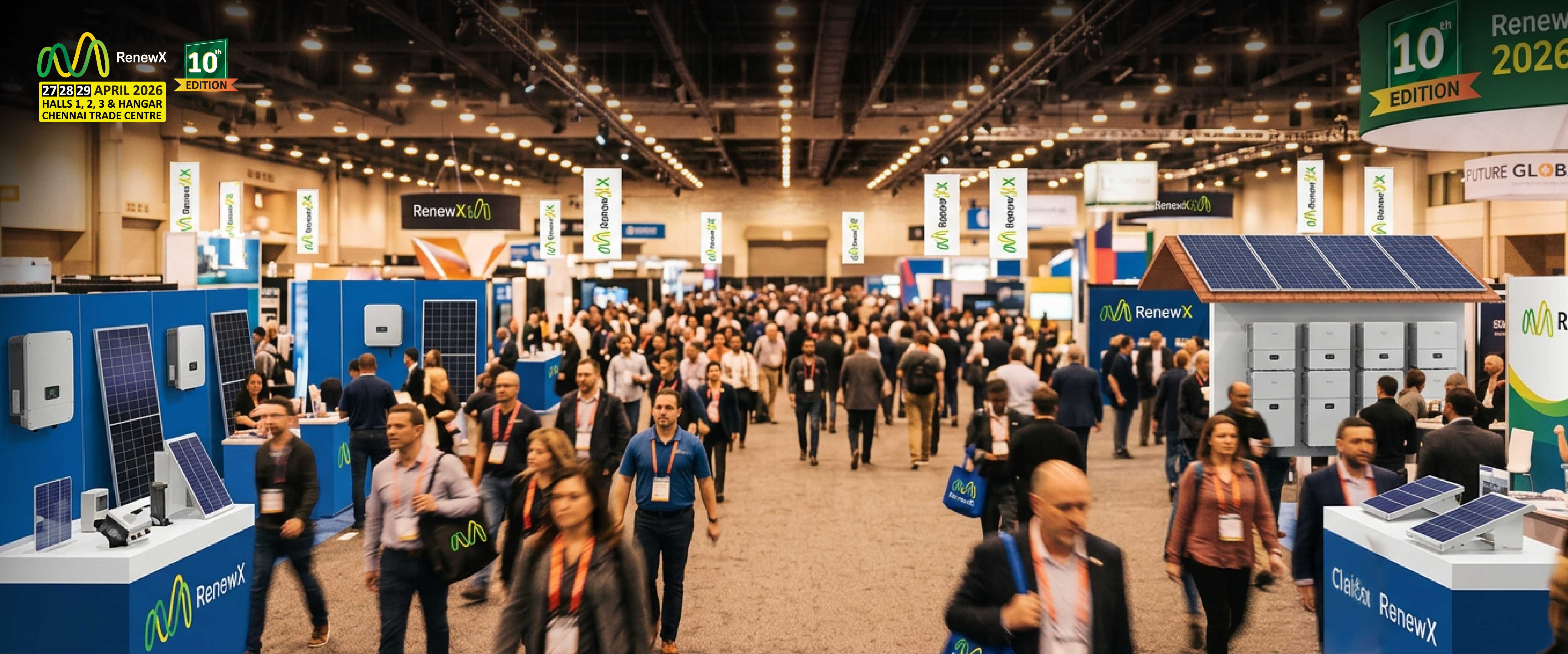
RenewX has positioned itself as a platform focused on accelerating South India’s renewable-energy and electric-vehicle market. The event is organised by Informa Markets and brings together the technologies, businesses, installers, developers, and energy stakeholders shaping the region’s clean-energy transition.
Solaire’s presence around RenewX 2026 reflects a simple idea: solar adoption works best when every part of the system is designed to work together.
Why solar inverters matter
Solar panels generate direct current, or DC, electricity. Most homes, commercial sites, and grid-connected systems use alternating current, or AC, electricity. A solar inverter performs the essential conversion from DC to AC, making solar energy useful for everyday loads and compatible with the electrical system.
But modern inverters do much more than convert power.
A high-quality inverter can help manage solar generation, track maximum power from panel strings, maintain stable operation under changing grid conditions, coordinate with battery storage, manage export limits, collect performance data, and provide system-level protection.
The right inverter influences:
- Solar energy yield and day-to-day system performance
- Compatibility with the grid and local electrical requirements
- Safety and protection against abnormal operating conditions
- Battery integration and backup capability
- Monitoring visibility for installers and asset owners
- Expansion flexibility as energy use increases
- Long-term reliability for residential, commercial, and utility projects
For this reason, buyers should not choose an inverter based only on its kW rating. The system should be selected around the project’s purpose, power demand, grid conditions, load profile, roof or site characteristics, battery requirements, and future plans.
Solaire’s product range is built to support those different requirements, from a home rooftop system to larger commercial and utility-scale installations.
Solaire on-grid inverters for rooftops
For many Indian homes, offices, shops, schools, warehouses, and commercial facilities, the immediate purpose of solar is to reduce daytime electricity purchases.
An on-grid solar inverter is designed for this use case. It converts electricity from the solar array into AC power that the property can use in real time. When solar generation is available, the building can consume solar power before drawing additional electricity from the grid.
Solaire On-Grid Inverters are designed for residential and commercial rooftop installations, with grid-compliance capability, wide MPPT ranges, stable operation, and a focus on maximising solar yield under varying grid conditions.
What is MPPT and why does it matter?
MPPT stands for Maximum Power Point Tracking. Solar-panel output changes throughout the day because of sunlight intensity, temperature, shading, panel orientation, and other site conditions.
An inverter’s MPPT function helps it identify and operate at the voltage and current point where the solar array can deliver the highest available power. Wider MPPT ranges can give installers more flexibility when designing panel strings for complex rooftops or variable conditions.
This matters particularly for sites with:
- Multiple roof orientations
- Partial shading during parts of the day
- Different panel-string configurations
- Commercial roofs with structural or layout constraints
- Seasonal variation in solar production
For a customer, the result is straightforward: a well-designed on-grid system can increase direct solar use and reduce dependence on grid-supplied electricity during the day.
Who should choose an on-grid inverter?
An on-grid solar inverter is generally suitable for:
- Urban homes with reliable grid access
- Apartment common-area loads
- Villas and independent houses
- Retail stores and showrooms
- Clinics, schools, and offices
- Warehouses and light-industrial buildings
- Commercial facilities with strong daytime power use
However, an on-grid system is primarily intended for solar consumption and grid interaction. In a standard configuration, it does not necessarily keep the property powered during a grid outage. Sites that need backup should consider a hybrid inverter and appropriately designed battery storage.
Solaire hybrid inverters for solar plus backup
Energy reliability has become as important as energy savings. Homes want lights, Wi-Fi, refrigeration, security systems, and selected sockets to remain operational during outages. Businesses may want protection for IT equipment, critical processes, lighting, billing systems, communications, or refrigeration.
This is where a hybrid solar inverter becomes valuable.
Solaire Hybrid Inverters combine solar generation, battery storage, and intelligent grid-export control in a single integrated solution. They are designed to optimise on-grid performance while providing backup during outages, maximising solar use, managing export limits, and delivering intelligent energy management for modern residential and commercial installations.
A hybrid system can use solar power in several ways:
- Supply daytime loads directly from solar generation.
- Charge the connected battery with available solar energy.
- Draw power from the grid when solar production is insufficient.
- Supply designated backup loads from the battery during an outage.
- Manage solar export where the installation requires export control.
This flexibility makes a hybrid solar inverter particularly relevant for households and businesses that want both electricity-bill savings and resilience.
When should a customer choose hybrid?
A hybrid solution can be appropriate when:
- Grid supply is unreliable or outages affect daily operations
- The site has critical loads that should remain on during an outage
- The owner wants to add a battery now or in the future
- Electricity consumption continues into the evening
- The property needs more control over solar generation and export
- The user wants smart energy management rather than solar-only generation
- A commercial facility wants to reduce diesel-generator dependence
For example, a home may use solar energy to run daytime loads, store surplus solar energy in a battery, and use that stored energy to support lights, fans, Wi-Fi, refrigerator circuits, and security systems when the grid goes down.
The system should be designed around critical loads, not simply around the entire connected load of the property. This can help make the installation more efficient and cost-effective.
Solaire lithium batteries for dependable storage
Battery storage changes what solar can do. Without a battery, a rooftop system mainly produces electricity when the sun is available. With storage, solar energy can be retained for later use.
Solaire Lithium Energy Storage Batteries use LFP chemistry, also known as lithium iron phosphate. Solaire describes these batteries as safe, thermally stable, scalable storage solutions for hybrid solar systems, with reliable backup power, high-discharge capability, and flexible capacity expansion.
Why LFP battery chemistry matters
A battery is not just an add-on. It is a central part of a hybrid energy system, particularly where backup is required. Battery choice affects how much energy can be stored, how much power can be delivered at one time, how the system responds during an outage, and how easily the storage capacity can expand.
Lithium iron phosphate batteries are widely used in stationary energy-storage applications because they are associated with thermal stability and long service life when deployed in properly engineered systems. Solaire’s LFP battery range is designed for solar energy storage and scalable hybrid-system applications.
Battery storage can support
- Essential home loads during outages
- Evening consumption after solar generation falls
- Security, communications, and monitoring systems
- Refrigeration and selected commercial loads
- Solar self-consumption rather than immediate grid export
- Backup for remote or grid-constrained locations
- Reduced reliance on diesel-generator operation for selected loads
Battery capacity should be selected in kWh, based on how much energy the customer needs over a defined backup period. Inverter capacity is selected in kW, based on how much power must run at the same time.
For example, a 5 kW inverter may be capable of operating a 5 kW load, but the battery must still have enough usable kWh to support that load for the required duration. Good solar design considers both dimensions.
Utility-scale inverters for larger solar plants
India’s energy transition includes far more than home rooftops. Commercial and industrial solar projects, distributed utility installations, and large solar plants require equipment engineered for higher capacities, rigorous operating conditions, grid interaction, and asset-level performance visibility.
Solaire Utility-Scale Inverters are designed for high-capacity solar plants. The company positions them for grid-grade efficiency, advanced diagnostics, wide MPPT ranges, robust protection features, and stable, high-yield performance in large commercial and distributed utility installations.
At this scale, inverter selection becomes a project-performance decision. Developers and EPC partners must assess DC/AC configuration, site temperatures, grid requirements, string design, protection coordination, communication architecture, and long-term operations and maintenance.
A utility inverter should support the goals of the project across its operating life:
- High energy conversion efficiency
- Reliable operation under demanding site conditions
- Flexible solar-array design through MPPT capability
- Robust fault protection and diagnostics
- Compatibility with plant-level monitoring systems
- Support for efficient operations and maintenance
- Stable grid interaction for large installations
For commercial and utility projects, every percentage point of energy yield and every hour of avoidable downtime can affect economics. That is why dependable inverter technology, diagnostics, and data visibility are essential.
Monitoring that keeps solar visible
A solar system should not become invisible after commissioning. Owners, installers, and operations teams need a dependable way to track whether the system is generating energy as expected and to identify possible issues early.
Solaire’s connectivity accessories are designed to help users stay connected to their solar-data and monitoring environment. The product range includes the Solaire 4G Dongle, Solaire Wi-Fi V3.0, and Solaire LAN Dongle.
Solaire 4G Dongle
The Solaire 4G Dongle supports plug-and-play deployment, IP65 dust and water resistance, offline data storage, five-minute data-transfer intervals, and multi-operator support. It is specified for LTE-FDD, LTE-TDD, and GSM bands and operates across a stated temperature range of -35°C to +75°C.
This option can be useful for sites where wired internet is unavailable, unreliable, or impractical. It supports mobile-network connectivity for solar monitoring without relying on a customer’s local Wi-Fi network.
Solaire Wi-Fi V3.0
The Solaire Wi-Fi V3.0 is a plug-and-play monitoring accessory with IP65 protection, stable data transmission, offline data storage, adaptive antennas, and five-minute data-transfer intervals. It operates on 2.4 GHz Wi-Fi and has a stated operating range of -40°C to +85°C.
It can suit residential and small-commercial sites that have reliable local Wi-Fi available near the inverter installation.
Solaire LAN Dongle
The Solaire LAN Dongle provides an Ethernet-based connectivity option with plug-and-play functionality, IP65 protection, offline data storage, 10/100M Ethernet support, and five-minute data-transfer intervals.
For commercial installations with structured network infrastructure, LAN connectivity can offer a practical and stable way to connect inverter monitoring to the local network.
Why monitoring supports performance
Monitoring helps customers and service teams understand:
- Daily, monthly, and lifetime energy generation
- Current operating status
- Potential faults or communication issues
- Changes in expected system performance
- Whether the system is online and reporting
- Data needed for preventive maintenance and service support
For a homeowner, this may mean confidence that the rooftop system is working as intended. For an EPC company managing multiple client sites, it can mean faster diagnostics and better fleet-level oversight. For a commercial or utility asset owner, it supports operational decision-making based on actual system data.
One ecosystem, multiple applications
Solaire’s product portfolio is designed to support different categories of solar users rather than forcing every customer into one system type.
| Application | Suitable Solaire solution | Primary objective |
|---|---|---|
| Residential rooftop with daytime use | On-grid inverter | Reduce grid electricity consumption during the day |
| Home requiring power backup | Hybrid inverter + LFP battery | Solar savings plus essential-load backup |
| Retail, office, school, or SME | On-grid or hybrid inverter | Lower operating costs and improve energy resilience |
| Commercial facility with critical loads | Hybrid inverter + scalable storage | Energy management and selected backup |
| Large solar plant | Utility-scale inverter | Grid-grade conversion, diagnostics, and high yield |
| Remote or multi-site monitoring | 4G, Wi-Fi, or LAN dongle | Reliable system-data connectivity |
The best solution depends on the actual load profile, grid availability, energy priorities, site conditions, required backup duration, and planned expansion. A system that is perfect for a daytime commercial rooftop may not be the right fit for a home that needs overnight backup. Similarly, a large solar plant requires a different design approach from a small business installation.
What visitors can discuss with Solaire
A meaningful conversation at a renewable-energy event should begin with the customer’s energy challenge, not only a product catalogue.
Visitors, installers, developers, and channel partners can use a discussion with Solaire to explore:
- Whether on-grid, hybrid, or utility-scale inverter technology matches the project
- How solar-plus-storage can support essential loads during outages
- How to choose battery capacity around real backup requirements
- How to plan for future expansion in panels, loads, and storage
- Which monitoring accessory is best suited to the site’s connectivity conditions
- How to improve visibility across one or multiple solar installations
- How grid conditions, roof design, load timing, and export requirements affect system selection
- How to build a more reliable and scalable solar solution for customers
For installers and EPC companies, selecting a solar inverter company in India is also about partnership quality: product suitability, technical clarity, compatibility, monitoring tools, service support, and the ability to build systems that customers can understand and trust.
The future is solar, storage and intelligence
The next phase of India’s solar market will not be defined only by installed panel capacity. It will be shaped by how intelligently solar energy is converted, consumed, stored, monitored, and integrated with the grid.
On-grid solar will remain important for homes and businesses seeking daytime savings. Hybrid systems will grow in relevance as customers place greater value on backup and energy resilience. LFP batteries will support greater control over when solar energy is used. Utility-scale inverters will remain essential to large solar installations that must deliver reliable energy at scale. Monitoring will help every category of customer make solar performance visible.
That is the complete story Solaire brings to RenewX 2026: solar technology designed not as isolated equipment, but as an integrated energy solution.
From residential rooftops and hybrid backup systems to commercial installations, utility-scale plants, and connected monitoring, Solaire offers a portfolio built for the realities of India’s evolving energy landscape.
For customers, partners, and industry stakeholders, the conversation is no longer simply about installing solar. It is about choosing the right inverter, the right storage strategy, the right monitoring solution, and the right long-term pathway toward cleaner, smarter, and more dependable energy.