10 FAQ Questions for Solar Energy Investment & Systems Types
Why Solar Energy Is The Most Cost-Effective Renewable Energy Source
Solar has become India's fastest-growing renewable energy source for one fundamental reason: cost efficiency. Today's modern solar solutions offer unprecedented value for homeowners and businesses.
The industry standard for measuring energy cost is LCOE (Levelized Cost of Electricity) – the total cost to generate one unit of electricity over a system's entire lifetime, accounting for installation, maintenance, and operation.
Solar's cost advantage stems from several factors: no ongoing fuel requirements, minimal maintenance compared to mechanical renewable systems, and broad geographic applicability across India. Unlike wind power (which requires specific windy locations) or hydroelectric systems (which need suitable geography), solar installations function effectively across all Indian regions.
This LCOE advantage is why solar capacity additions lead other renewables, and why government incentives prioritize solar adoption.
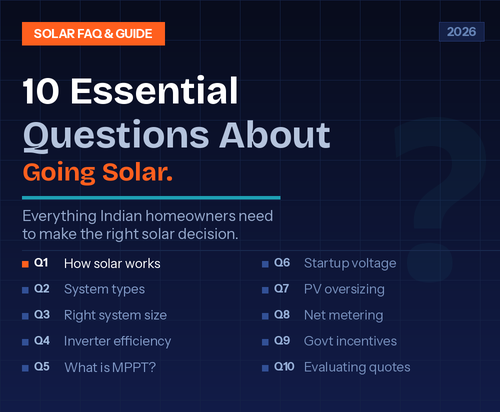
10 Essential Questions About Going Solar
Q1: How does going solar help eliminate or significantly reduce your electricity bill?
Solar energy allows you to generate your own electricity directly from sunlight, dramatically reducing or completely eliminating your dependence on grid electricity and the monthly bills that come with it.
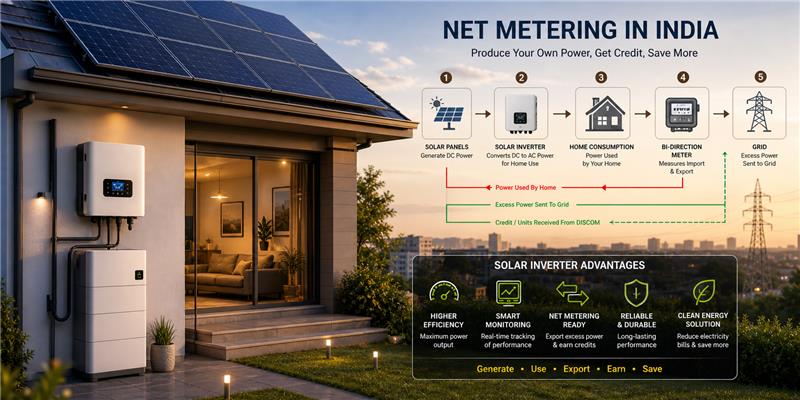
When solar panels generate electricity during the day, you use that power immediately to run your lights, fans, AC, and appliances. Excess electricity that your home doesn't use flows back to the grid, and you receive credits for that exported power. At night or on cloudy days, you draw power from the grid but offset it with the credits earned from your daytime exports.
The real value: Over time, the electricity you generate offsets the electricity you purchase from the grid. Many homeowners see their monthly electricity bills drop dramatically, with only minimal night-time consumption remaining on the grid. After your system pays for itself, you essentially have free electricity for the rest of your system's operational lifespan.
This is why a solar energy investment eliminates monthly electricity costs rather than reduces them – turning what was a recurring expense into a one-time asset that pays dividends for decades.
Q2: What are the three main solar energy system types, and which is right for me?
On-Grid Systems:
Connect directly to your local electricity grid without battery storage. Panels generate electricity during the day, you use it immediately, and excess flows to the grid (earning credits). Ideal for urban areas with reliable power supply. Solaire's X1 ZIP and X1 ZAP single-phase on-grid inverters deliver high efficiency for residential installations, or the X3 ZOOM and X3 LITE three-phase systems for commercial properties.
Hybrid Systems:
Combine grid connection with batteries for intelligent energy management and peak hour optimization. During peak tariff hours, hybrid inverters use stored battery energy to reduce grid consumption, significantly lowering electricity costs. Excess daytime solar generation charges the battery strategically, ensuring you have stored power during high-tariff periods. This peak-hour load shifting is the primary financial advantage – you're essentially buying electricity at off-peak rates and using it during peak-tariff hours when grid rates are highest. The battery also provides seamless backup during grid outages as a secondary benefit. Solaire's SH-GEN.S (single-phase) and SH-GEN.X (three-phase) hybrid inverters integrate with lithium battery storage, enabling intelligent peak-hour energy compensation, reduced tariff costs, and optimized grid export timing – all while maintaining grid connectivity for maximum flexibility.
Off-Grid Systems:
Operate completely independently from the electrical grid using large battery banks for 24/7 power. Requires battery capacity for multi-day autonomy. Suited for remote locations without grid infrastructure.
Selection guidance: On-grid suits urban areas with reliable supply and standard tariff structures. Hybrid addresses both peak hour tariff reduction and power availability concerns – particularly valuable in regions with time-of-use (ToU) tariffs. Off-grid serves remote regions. Your local grid's reliability and tariff structure should guide this decision.
Q3: How do I determine the right system size for my home?
System sizing is straightforward – it's based entirely on your electricity consumption.
Start with your monthly electricity bill, which displays consumption in kWh (units). Calculate your daily average consumption, then work with an installer who consults solar yield data for your specific geographic region.
A qualified installer will analyze your specific address, roof orientation, and shading patterns to recommend optimal sizing. They'll typically suggest sizing that offsets the majority of your consumption on on-grid systems, while maintaining some grid connectivity for stability and seasonal flexibility.
For hybrid systems, the sizing also accounts for peak-hour consumption patterns – identifying which hours have the highest tariffs and sizing battery capacity to cover that peak usage window.
Get a free system size assessment from Solaire's experts. Contact us for a personalized consultation.
Q4: What is inverter efficiency and why should I care about it?
Inverter efficiency represents what percentage of DC power from your panels successfully converts to usable AC power. The remaining percentage dissipates as heat in the inverter's electronics.
Why this matters: Even seemingly small efficiency differences compound dramatically over the system's lifetime. A more efficient inverter loses less electricity as waste heat, directly translating to more usable electricity generated from identical panels.
A high-efficiency inverter also typically uses better components, extending operational life and reducing the need for replacement or repairs over your system's decades of operation.
Solaire's efficiency advantage: Solaire inverters achieve up to 99.03% peak efficiency – among the highest in the industry. This efficiency translates directly into additional electricity generation that accumulates substantially over your system's lifespan, making the premium quality more than worthwhile.
Q5: What is MPPT (Maximum Power Point Tracking) and why does it matter?
MPPT is technology in solar inverters that continuously optimizes the voltage and current output from your panels to extract maximum power at all operating conditions.
Solar panels operate at varying voltage levels depending on sunlight intensity, panel temperature, and shading patterns. MPPT automatically scans operating voltages multiple times per second, identifying the exact point where panels generate maximum power, then adjusts accordingly.
Why higher MPPT capability matters: A single-MPPT inverter treats all panels as one unit. If one panel is shaded or operating at lower capacity, it reduces the output of the entire string. A multi-MPPT inverter uses separate trackers for different panel strings – if one string is shaded, it optimizes independently, while other strings continue generating at peak capacity.
Performance impact: Multi-MPPT systems deliver noticeably higher annual energy output, with benefits most pronounced in real-world installations where partial shading, varying panel angles, or roof complexities create non-uniform generation across strings.
Solaire's X3 PRO and X3 MAX series feature advanced multi-MPPT technology for superior performance in complex installations.
Q6: What does "50V startup voltage" mean and why is it significant?
50V startup voltage refers to the minimum DC voltage at which your solar inverter begins producing AC output. This specification has measurable impact on daily energy production, particularly in morning and evening hours.
Standard inverters typically require much higher voltage to operate. Premium inverters operating at just 50V startup voltage begin generating electricity earlier in the morning and continue later into the evening – capturing additional generation during low-light conditions.
Why it matters: This extended operating window directly translates to additional annual electricity generation that accumulates over your system's lifespan.
Solaire's 50V advantage: Solaire's advanced inverters feature 50V ultra-low startup voltage technology, enabling earlier morning generation and extended evening production. This single innovation delivers measurable additional electricity over your system's lifetime.
Q7: What is PV oversizing and should I consider it?
PV oversizing refers to installing solar panel capacity beyond the inverter's rated capacity – a practice that maximizes energy capture while operating safely within limits.
During peak sunlight, oversized panels generate excess power. The inverter's built-in protection automatically clips this excess to its rated capacity without damage. During morning, evening, and cloudy conditions, the panel array operates below rated capacity, allowing the inverter to draw full power from available panels.
Result: Oversizing increases effective capacity utilization hours and annual energy generation. The additional panel investment generates additional electricity value that recoup costs over the system's lifetime.
Safety: Modern inverters are engineered to safely handle oversized inputs. This is standard professional practice – inverter clipping is intentional and causes no equipment damage.
Q8: How does net metering work and what financial returns are possible?
Net metering is a billing mechanism allowing grid-connected solar installations to export excess generation to the distribution grid during high-generation periods, with net settlement monthly or annually.
Your electricity meter becomes bidirectional – recording both electricity consumed from the grid and electricity exported to the grid. Settlement occurs based on net difference.
Financial impact: Net metering transforms solar from an energy-saving investment into a potential income-generating asset. Export credits reduce or eliminate electricity bills, depending on consumption patterns and generation levels.
For hybrid system owners: Smart inverters optimize when to export to the grid. Rather than exporting during peak tariff hours (when you'd use stored battery power instead), the system prioritizes exporting during off-peak hours when rates are lower but export compensation remains valuable. This layered strategy – peak shaving with battery, off-peak export to grid – maximizes financial returns.
Policy variations: Net metering policies vary by state and DISCOM. Check your specific utility's policy regarding compensation rates, carryover rules, and settlement frequency. Some states offer excellent terms; others have limitations on surplus credit amounts or carryover periods.
Q9: What government incentives are available for solar?
Multiple government schemes reduce effective system costs through direct subsidies and favorable financing.
Central Government Programs:
- Residential subsidies available through National Solar Mission
- Additional schemes for farmers (PM-KUSUM) offering enhanced subsidies
State-Level Programs:
- Interest-free or subsidized loans
- Additional generation incentives
How to access: Contact your state's nodal agency or DISCOM office with land ownership proof and electricity bill. Processing typically occurs within reasonable timeframes after submission.
The subsidy amount varies significantly by state and program, but typically reduces your net investment substantially.
Q10: How do I evaluate competing solar installer quotes and identify quality differences?
Solar quotes vary dramatically in underlying quality assumptions. Systematic evaluation prevents costly decisions.
Panel Quality:
Examine efficiency ratings, warranty terms, and expected degradation rates. Premium manufacturers differ significantly from budget brands.
Inverter Specifications:
Compare efficiency ratings, warranty duration, features (MPPT capabilities, startup voltage, smart monitoring). Premium units offer superior performance and longevity.
Balance of System:
Evaluate wiring quality, mounting structure materials, and earthing design comprehensiveness.
Installation Quality:
Assess whether quotes include site assessment, shading analysis, optimization, and post-installation performance testing.
Service Network:
Verify installer credentials, service response capabilities, and long-term support infrastructure.
Evaluation approach: Don't choose based on lowest upfront price. Instead, evaluate total cost of ownership (including maintenance, potential replacements, and performance differences). The lowest-cost system often becomes most expensive when accounting for efficiency losses, shorter lifespan, and replacement costs over time.
Why Choose Solaire for Your Solar Investment
When evaluating quotes, consider Solaire – India's trusted solar inverter manufacturer delivering premium quality backed by proven reliability:
✅ Industry-Leading Efficiency: Up to 99.03% peak efficiency – maximize electricity generation from identical panels
✅ Advanced Technology: 50V ultra-low startup voltage, multi-MPPT architecture, smart monitoring, and peak-hour optimization for hybrid systems
✅ Peak Hour Advantage (Hybrid Systems): Intelligent energy management that reduces peak-tariff consumption, lowering electricity costs significantly through strategic battery charging and load shifting
✅ Proven Reliability: 24/7 Indian support with guaranteed response time, backed by 25+ years of service excellence
✅ Comprehensive Warranty: Extended warranty with full after-sales support network across India
✅ Performance Guarantee: Real-world tested across all Indian climate conditions, from coastal humidity to desert heat
Trust the brand that's been powering Indian solar homes and businesses since 1998.
Ready to make your solar decision with confidence?
Get a free system assessment and quote from Solaire experts who understand your local conditions and tariff structures.