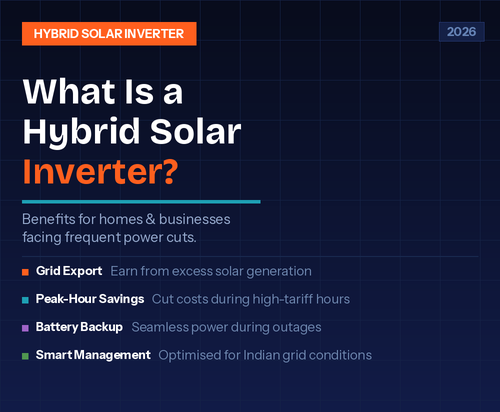
What Is a Hybrid Solar Inverter? Benefits for Homes & Businesses Facing Frequent Power Cuts
What Is a Hybrid Solar Inverter? Benefits for Homes & Businesses Facing Frequent Power Cuts
The Core Idea
A hybrid solar inverter does three things your regular on-grid inverter can't:
- Sells excess solar electricity back to the grid (earning you money)
- Stores solar energy in a battery (for use during peak-price hours or power cuts)
- Switches to battery instantly when the grid fails (keeping your power on)
That's it. Everything else flows from these three capabilities.
Why Grid Export Matters Most
When your solar panels produce more electricity than you're using, traditional systems waste it. Hybrid systems capture it and send it back to the grid.
Your electricity company measures how much you've exported and credits your account. This is genuine income – the grid literally buys your excess solar electricity.
For homeowners: That credit reduces your monthly bill. Export enough, and your bill drops dramatically.
For businesses: That credit offsets your consumption. A business with a 15-20 kW system can generate meaningful export income, especially on evenings and weekends when you're closed but the sun was strong earlier.
This grid export capability is why hybrids exist. It's the primary financial advantage.
Peak-Hour Optimization: The Secondary Benefit
If your electricity company charges different rates at different times (peak hours cost more, off-peak hours cost less), a hybrid system adds another layer of savings.
The battery charges during cheap off-peak hours when your solar is abundant. During expensive peak hours, you use that stored energy instead of buying from the grid. You're essentially shifting when you consume electricity to take advantage of lower rates.
This only helps if your DISCOM has time-of-use tariffs. But if they do, it's substantial additional savings beyond grid export income.
Battery Backup: The Bonus Protection
A hybrid system also keeps your home or business running during power cuts. When the grid fails, the inverter detects it instantly and switches to battery power – so seamlessly you might not even notice.
For homeowners facing frequent power cuts, this is meaningful. For businesses, it's operational protection – no lost productivity, no customer service interruption.
But this isn't why you buy a hybrid. You buy it for grid export. The battery backup is the bonus that makes the investment even more valuable.
Hybrid vs On-Grid: What's the Real Difference?
On-Grid (no battery):
- • Generates solar electricity
- • Exports excess to the grid
- • Stops working during power cuts
- • Cheaper upfront
Hybrid (with battery):
- • Generates solar electricity
- • Exports excess to the grid
- • Stores energy in battery
- • Uses battery during peak hours or power cuts
- • More expensive upfront
The battery is the differentiator. It costs more money, but it adds two capabilities: peak-hour tariff optimization and backup power during outages. Whether that additional cost is worth it depends on your situation. If you have frequent power cuts or time-of-use tariffs, hybrid makes financial sense. If your grid is reliable and tariffs are flat, on-grid might suffice.
Cost Reality: Understanding Hybrid Solar Inverter Price and ROI
Hybrid systems cost more because of the battery component. But the math works like this:
- You pay more upfront for the battery
- You get the same grid export income as on-grid
- You get additional peak-hour savings (if applicable)
- You get backup power during outages
- Most homeowners/businesses recoup the battery cost within 5-7 years through extra savings
- After that, it's all additional benefit
Best Hybrid Solar Inverter in India: Solaire's Two Models
SH-GEN.S
Single-Phase, 3-6 kW
For homes and small properties with standard single-phase electricity supply. Compact, efficient, handles typical household loads with battery backup.
SH-GEN.X
Three-Phase, 8-20 kW
For larger homes and businesses with three-phase supply. Handles higher power demands, can operate multiple units in parallel for scalability, designed for commercial peak-hour optimization.
Both models prioritize what matters: maximizing grid export income through high efficiency, intelligent peak-hour management, and proven reliability across Indian climate conditions. When comparing best solar inverter brands, Solaire's hybrid offerings stand out for engineered performance and proven reliability in real-world conditions.
Who Should Choose Hybrid?
Yes, if:
- Your electricity company allows grid export (most do)
- You want to maximize income from excess solar generation
- You have time-of-use tariffs (additional savings opportunity)
- You're in an area with frequent power cuts (bonus protection)
No, if:
- Your electricity company doesn't allow grid export
- You only want basic consumption offsetting
The real deciding factor isn't power cuts – it's grid export opportunity. Backup power is the bonus that comes with it. Choose hybrid if you want to maximize grid export income. The backup protection during outages is the additional value you get. When asking which brand is best for solar inverter options, evaluate based on grid export capability, peak-hour optimization features, and proven reliability in your region.
The Real Question
Before choosing hybrid or on-grid, ask your electricity company:
- Do you allow grid export? (Most do, but verify)
- Do you have time-of-use tariffs? (If yes, hybrid gains value)
- How do you credit exported electricity?
These answers determine whether hybrid's additional cost makes financial sense for your specific situation.
Next Steps
Solaire can analyze your specific consumption patterns, tariff structure, and power cut frequency to show you exactly:
- How much grid export income you can generate
- Peak-hour savings potential (if applicable)
- How backup power protects your investment
- Full financial ROI for your situation
Get a personalized hybrid solar inverter analysis today
No obligation, specific to your home or business
-1765857366.png)