Utility-Scale String Inverters Why They Are Replacing Central Inverters
Utility-Scale String Inverters: Why They Are Replacing Central Inverters
Discover why a string inverter architecture is gaining ground in utility-scale solar projects, and how it compares with a central inverter for a solar farm.
For years, central inverters were the default choice for the largest solar projects. Their appeal was clear: combine a large amount of DC power in one location, convert it through a high-capacity unit, and scale the plant around a central architecture.
That approach still has a role in the right project. But utility-scale developers are increasingly looking at high-power string inverter architectures instead. The reason is not that central inverters have suddenly become irrelevant. It is that modern string inverters now offer a compelling combination of modularity, monitoring, resilience, design flexibility, and easier maintenance for many large installations.
In this guide, we explain why the shift is happening, where a string inverter can improve the performance of utility-scale solar, and why the decision between string and central inverter design should be based on site conditions and project priorities — not old assumptions.
To explore systems for large solar projects, visit Solaire's utility-scale inverter solutions.
The old utility-scale model: centralised conversion
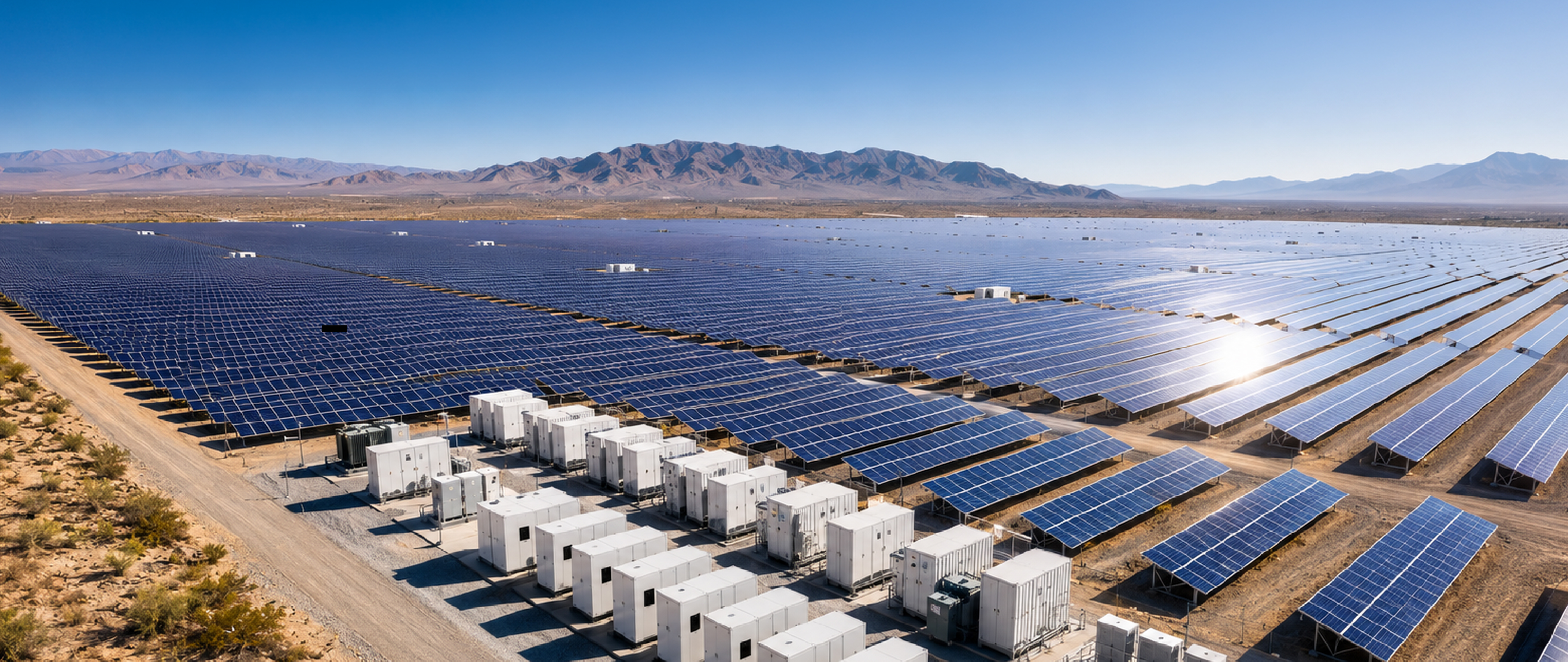
A central inverter gathers DC power from many panel strings, typically through combiner infrastructure, and converts that energy into AC power at a single, central point. This design can deliver compelling economies of scale, particularly on very large, uniform sites where minimising inverter hardware cost per watt is the leading priority.
For a large, unshaded and consistently oriented solar farm, centralised conversion can simplify the number of inverter units that need to be procured and maintained. That is why central inverters remain relevant for certain very large projects and for EPC teams with established central-inverter design and operations models.
But concentration creates a trade-off. When a large central unit is unavailable, a substantial portion of the plant can be affected. A utility-scale project therefore has to assess not just the price of the unit, but the operational impact of downtime, repair logistics, and the size of the affected generation block.
The new model: distributed power conversion
A string inverter architecture distributes conversion across multiple smaller, independent inverter blocks. Instead of sending a large volume of DC power toward one central unit, strings are managed across numerous high-power inverters installed closer to the array.
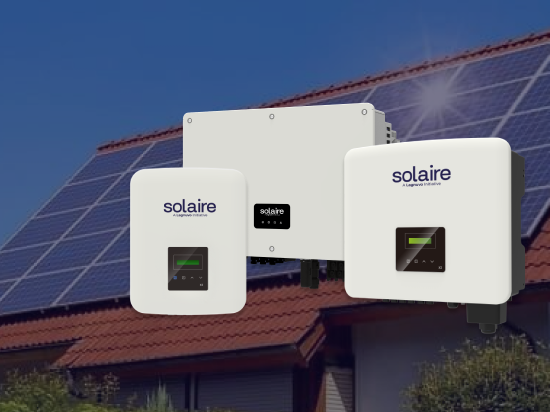
Solaire describes its utility-scale offering as a high-power solar inverter for large plants that converts DC electricity from solar panels into grid-ready AC power. Its utility-grade string-inverter material highlights multiple inverter blocks, wide DC-voltage capability, high-capacity MPPT channels, and advanced grid-support functions for continuous operation.
The key difference is modularity. Each inverter block can be installed, tested, monitored, and serviced independently. That changes both how a plant is built and how it performs when one component requires attention.
1. Reduced single-point-of-failure risk
This is one of the strongest reasons developers are considering string architecture. In a centralised design, a central inverter failure can take a large block of generation offline. In a distributed string design, a fault in one inverter usually affects only the portion of the plant assigned to that unit; the remaining inverter blocks can continue generating.
The World Bank's utility-scale solar guidance notes that string inverters can improve plant performance in some situations and are simpler to maintain. It also highlights the practical benefit of keeping spare string units on site and replacing them without highly specialised personnel.
For a solar farm, this can translate into better operational resilience. Rather than treating plant availability as dependent on a small number of large assets, the project spreads risk across many independent conversion points.
2. More granular MPPT and energy harvest
Maximum power point tracking, or MPPT, allows an inverter to optimise panel-side operating conditions. A distributed string inverter system generally provides MPPT at a more granular level than a centralised system.
This matters when real site conditions are not perfectly uniform. Variations in module performance, terrain, soiling, bifacial gain, tracker behaviour, orientation, or partial shading can create mismatch between strings. With more independent MPPT channels, the plant can manage these variations more effectively instead of allowing weaker sections to influence a much larger block of DC generation.
World Bank guidance specifically identifies string-level independence as useful where module orientation differs, panel specifications vary, or shading is present. Solaire's X3 Grand utility-scale inverter also highlights I-V curve scanning and detailed string-level performance analysis, showing why granular visibility is increasingly important in large plants.
3. Easier maintenance and faster replacement
A large central inverter can require more specialised repair planning, heavier logistics, and longer service coordination. A modular string inverter is typically easier to isolate, remove, replace, and return to service.
That does not mean utility-scale O&M becomes effortless. Large plants still need disciplined maintenance planning, trained teams, spare-parts management, and robust monitoring. But distributed architecture can make it easier to schedule interventions without taking a major part of the plant offline.
Independent industry comparison work also points to smaller form factors, simpler repairs, shorter spare-parts requirements, and less need for special equipment as potential O&M advantages of utility-scale string architectures.
For project owners, this is one reason the decision to buy solar inverter equipment should be evaluated as a lifetime operations decision, not only an upfront procurement decision.
4. Greater layout flexibility
Not every solar farm sits on perfectly flat, uniform terrain. Some sites have irregular boundaries, varied topography, different tracker blocks, or design constraints that make a rigid, centralised DC collection approach less attractive.
A string inverter layout allows developers to deploy inverter capacity across the site in smaller blocks. This can reduce the need for long, high-current DC cable runs and make it easier to adapt the electrical design to the physical layout of the array.
Solaire's utility-scale guidance notes that distributed inverter blocks can reduce dependence on large combiner hardware, limit long high-current DC wiring, and allow each block to be commissioned independently. For EPC teams, that can support simpler layouts and more phased construction workflows.
5. Better monitoring at the string level
Plant performance is not just about total MW output. It is about identifying why one section is underperforming before the loss becomes significant.
A string inverter architecture can provide more granular operational data, enabling teams to identify weak strings, investigate mismatch, compare blocks, and target maintenance more precisely. I-V curve scanning, string-level diagnostics, and block-level monitoring can help transform maintenance from a reactive process into a more data-led one.
Solaire's utility-scale inverter product information specifically identifies I-V curve scan capability and detailed string-level performance analysis as features for high-power panel and large-string configurations.
Is central inverter technology truly being replaced?
The honest answer is not everywhere. A central inverter can still be a strong option for very large, highly uniform projects where the lowest inverter cost per watt, a proven centralised service model, and a concentrated plant layout are the priorities.
But the industry direction is clear: high-power string inverters are no longer restricted to smaller commercial systems. They are increasingly credible in utility-scale solar because their technical capabilities have grown while developers have placed greater value on uptime, granular monitoring, modular serviceability, and flexible plant design.
The better question is not "Which technology always wins?" It is "Which architecture gives this site the best lifetime outcome?" The answer depends on project capacity, terrain, module layout, grid requirements, labour availability, O&M strategy, and the financial cost of downtime.
What to assess before you buy
Before deciding whether to buy solar inverter equipment based on a string or central architecture, we recommend evaluating:
- The site's terrain, shading risk, and array layout
- String-level mismatch risk and number of MPPT channels needed
- Expected downtime impact of one inverter block failing
- DC and AC cabling design, transformer configuration, and balance-of-system costs
- Local service capability, spare-parts plan, and replacement time
- Monitoring depth, data requirements, and O&M model
- Grid-code and plant-controller requirements
A serious utility-scale solar project should use a full technical and financial comparison rather than relying on a single hardware-price metric.
A modular future for utility-scale solar
Utility-scale string inverters are gaining ground because they respond to the operational realities of modern plants. They distribute risk, provide more granular control, support flexible layouts, and help maintenance teams act on better data.
For the right solar farm, a string inverter architecture can make the plant more resilient and easier to manage across its operating life. A central inverter still has a place, particularly at the largest and most uniform sites. But as developers prioritise availability, visibility, and lifecycle performance, distributed string technology is becoming one of the defining designs in modern utility-scale solar.
To evaluate the right architecture for your project, explore Solaire's industrial and utility-scale inverter range.