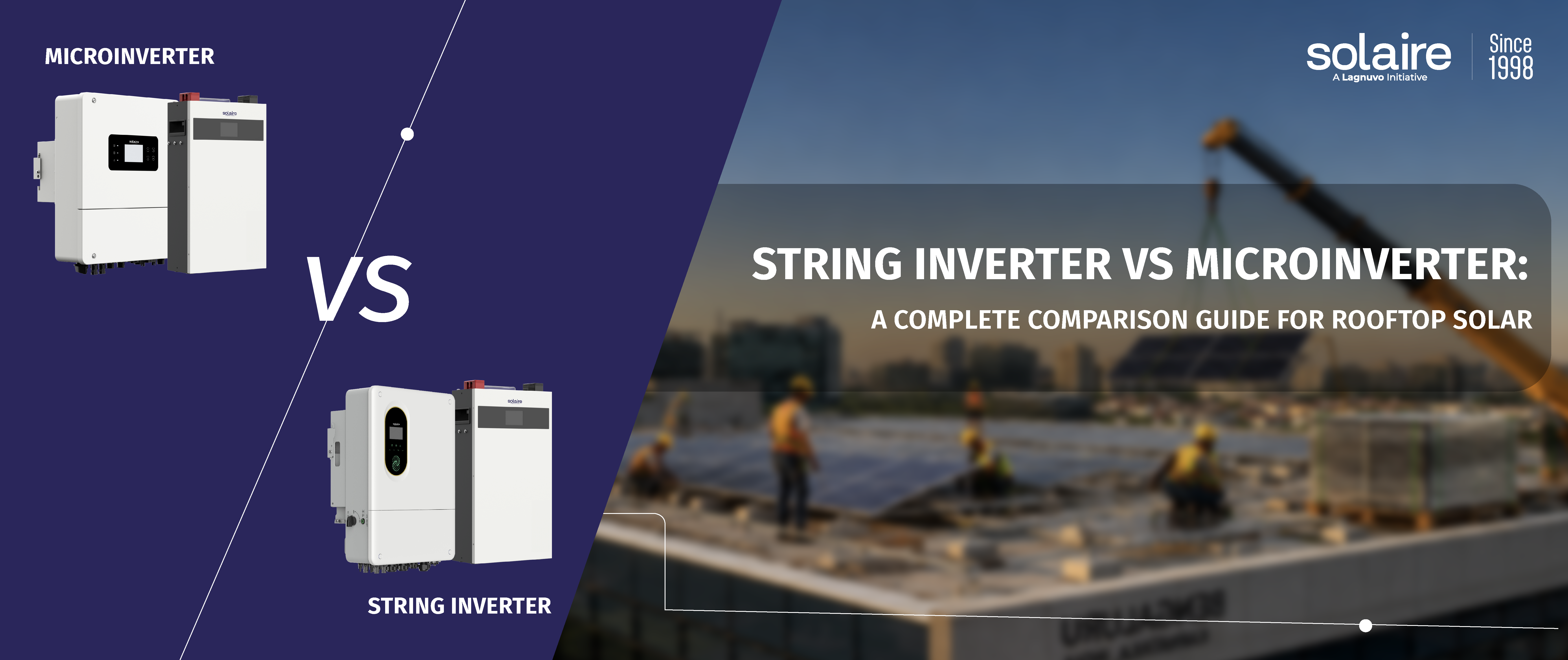
String Inverter vs Microinverter: A Complete Comparison Guide for Rooftop Solar
String Inverter vs Microinverter: A Complete Comparison Guide for Rooftop Solar
When planning a solar setup, one of the biggest technology choices is the inverter architecture. Panels may look similar from the outside, but the way solar energy is converted can significantly affect cost, monitoring, scalability, and day-to-day performance. That is why the debate around string inverter versus microinverter systems matters so much.
In this guide, we compare both approaches in practical terms so homeowners and businesses can better understand which one fits their rooftop solar needs. We will look at how each technology works, where each performs best, and how the right choice depends on roof design, shading, and project priorities.
For readers comparing broader inverter categories, Solaire's guide to solar panel inverters, types, and functions provides useful background before diving into this comparison.
What is a string inverter?
A string inverter is the most common and cost-effective type of solar inverter for residential and small commercial systems. It connects multiple solar panels in a series, or string, and converts the combined DC output into AC electricity through one central inverter.
This design works especially well when all panels sit on a simple roof layout and receive similar sunlight. In such cases, a string inverter can deliver strong performance with a lower upfront cost and simpler system architecture.
Solaire's solar inverter portfolio reflects this kind of inverter-led approach for residential and commercial rooftop solar applications.
What is a microinverter?
A microinverter is a small inverter attached directly to each solar panel. Instead of converting power centrally, it converts DC to AC at the panel level, allowing every panel to operate more independently.
This is one of the biggest reasons a microinverter can improve performance in systems affected by shade, uneven roof angles, or varying panel orientations. Because each panel works on its own, a weaker panel does not drag down the output of the whole system in the same way it can in a string setup.
Microinverters also make panel-level monitoring easier, which can simplify troubleshooting and provide more granular visibility into how a rooftop solar system is performing over time.
The biggest difference: centralized vs panel-level conversion
The fundamental difference between a string inverter and a microinverter is where the DC-to-AC conversion happens. A string inverter manages the output of multiple panels together, while a microinverter does the conversion separately on each panel.
This design difference has a direct impact on performance. In a string-based system, output can be limited by the lowest-performing panel in the string. In a microinverter-based system, one shaded or underperforming panel has much less impact on the rest of the array.
That is why roof complexity matters so much in rooftop solar planning. Simple roofs often suit string systems well, while more complex roofs may benefit from microinverter architecture.
Cost and system simplicity
For many projects, a string inverter remains attractive because it usually comes with lower upfront equipment cost and a simpler overall system design. On straightforward roofs with minimal shading, this can make it a very practical choice.
A microinverter system is typically more expensive because it requires one unit per panel. The physical setup can also be more involved, especially on larger systems. However, that added cost may be justified when the roof layout or shading conditions would otherwise reduce system performance significantly.
Shading, monitoring, and expansion
If a rooftop solar system is expected to experience partial shade during the day, a microinverter often has an advantage. Panel-level conversion means that one shaded panel does not reduce the output of all the others in the same way it would in a string-based design.
Microinverter systems can also be easier to expand in some cases because additional panels can be added without redesigning around a single central inverter. By contrast, a string inverter is often most efficient when the overall roof layout is predictable, and the system is designed as one coordinated string arrangement from the start.
For users prioritising detailed monitoring and long-term visibility, microinverters also offer a stronger case because they allow panel-level performance tracking.
Which one is better for rooftop solar?
There is no universal winner between string inverter and microinverter systems. The better option depends on the project.
For a simple, shade-free rooftop solar setup where panels face the same direction and budget efficiency matters, a string inverter is often the more practical choice. It offers lower initial cost and a straightforward design path.
For roofs with multiple orientations, partial shading, or more demanding monitoring needs, a microinverter may offer better performance over time. It can also be a good option where future expansion flexibility is important.
Choosing with the right priorities
The best inverter decision is not just about technology labels. It is about how the roof behaves in real life and what the user expects from the system.
A string inverter remains a strong solution for many residential and small commercial rooftop solar projects because of its simplicity and value. A microinverter, on the other hand, becomes more compelling when shade, roof complexity, or panel-level performance visibility are key priorities.
In the end, the right comparison is not which technology sounds more advanced, but which one helps the solar system perform better in the conditions it will actually face. For users evaluating residential and commercial options, Solaire's solar inverter range offers a useful starting point for understanding how inverter selection fits into the wider solar system design.