Battery Energy Storage Systems (BESS) and Hybrid Inverters Explained
Battery Energy Storage Systems (BESS) and Hybrid Inverters Explained
Battery Energy Storage Systems and hybrid inverters are the two technologies converting India's rooftop solar boom into genuine round-the-clock energy independence, and understanding how they work together, rather than as separate purchases, is the difference between a solar system that only saves money during the day and one that delivers real battery backup at any hour.
What a BESS Actually Is
A Battery Energy Storage System (BESS) is the complete storage architecture that captures surplus electricity and releases it on demand, spanning everything from compact residential battery units to utility-scale installations supporting the grid. India's storage ambitions here are substantial: the Central Electricity Authority projects a national storage requirement of 411.4 GWh by 2031–32, of which 236.2 GWh is expected to come specifically from battery energy storage systems. As of mid-2026, India's cumulative installed battery capacity stood at roughly 9.3 GWh, a clear signal of how much this market still has to scale.
Energy storage at this scale isn't a single uniform product. It spans three distinct tiers based on application:
- Residential ESS units, sized for individual homes, supporting essential-load backup and daytime solar shifting.
- Commercial lithium iron phosphate (LFP) cabinets, modular, scalable storage for businesses, offices, and C&I facilities.
- Utility-scale BESS, large installations supporting grid balancing, renewable integration, and peak demand management.
Why Hybrid Inverters Are the Essential Link
A BESS cannot function in isolation, it needs a hybrid inverter to actually coordinate solar generation, battery charging and discharging, and grid interaction into one working system. This is the core idea behind innovative solar solutions that pair storage and conversion hardware as a single integrated unit rather than two independently sourced components.
A hybrid inverter performs several coordinated functions simultaneously:
- Converting DC solar generation into usable AC power for the home or business.
- Charging the connected battery with surplus solar energy during the day.
- Discharging stored battery power to run essential loads in the evening or during an outage.
- Managing grid import and export within regulatory limits.
- Switching automatically to battery backup the moment a grid failure is detected.
The Grid-Switchover Speed That Actually Matters
For battery backup to feel genuinely seamless rather than disruptive, the switchover speed from grid power to battery power is critical. Advanced hybrid inverter ranges are now engineered for sub-4-millisecond grid switchover, fast enough that sensitive electronics, routers, and most appliances never register the interruption at all. This kind of transfer speed, combined with the ability to oversize solar panel capacity relative to the inverter (some hybrid ranges support up to 200% PV oversizing), is what makes hybrid inverters a practical backup solution for load-shedding and unplanned outages, not just a theoretical one.
Why Certification Is Not Optional for BESS and Hybrid Inverters
Because a BESS and hybrid inverter combination handles high-voltage DC, battery chemistry risk, and direct grid interconnection, certification is the mechanism that actually protects buyers from fire risk, premature failure, and non-compliant installations. India's regulatory framework reflects exactly this concern: the Ministry of New and Renewable Energy's Solar Systems, Devices and Components Goods Order makes Bureau of Indian Standards (BIS) compliance mandatory for every inverter supplied domestically, while the Central Electricity Authority's safety regulations govern battery container clearances, earthing design, and ground-fault detection for storage installations.
Solaire's own certification standing is a useful illustration of what compliant equipment in this category should look like. Solaire's grid-connected inverter range is BIS certified to IS 16221-2:2015, and separately holds IEC 62109, IEC 61727, and IEC 62116 certification, covering electrical safety, grid-interconnection performance, and anti-islanding protection respectively. Solaire's inverters also meet the minimum efficiency standards that became mandatory in India from 1 January 2026, ranging from 93% efficiency at the 1–3 kW capacity band up to 98% for units above 20 kW, thresholds that only BIS-certified equipment is eligible to be labelled against. For export markets, Solaire's commercial and utility-scale hardware additionally carries grid-code certifications including EN 50549 and VDE 4105 (Europe), G99 (UK), AS/NZS 4777 (Australia), CEI 0-21 (Italy), and RD 1699 (Spain).
This matters for buyers evaluating any BESS and hybrid inverter pairing: certification should never be taken as a manufacturer's claim at face value. The practical standard to confirm before purchase includes:
- BIS certification under IS 16221-2:2015, verified model-by-model on the official BIS portal, not assumed manufacturer-wide.
- IEC 62109 for electrical, mechanical, and thermal safety.
- IEC 62116 for anti-islanding, confirming disconnection within the required time window during a grid fault.
- IEC 62619 safety certification for the battery component specifically, covering industrial lithium-ion cells, which has become the reference standard insurers and grid operators look for in BESS installations.
Why LFP Chemistry Dominates Modern BESS Design
Nearly all serious residential and commercial BESS products today use lithium iron phosphate (LFP) chemistry rather than older lithium-ion variants, specifically because LFP cells offer significantly better thermal stability, a critical safety factor given that battery fire risk is the single biggest concern regulators and insurers evaluate in any BESS installation. Solar batteries built on LFP chemistry also typically deliver longer cycle life and better performance across the wide ambient temperature swings common in Indian climates.
How This Comes Together in Practice
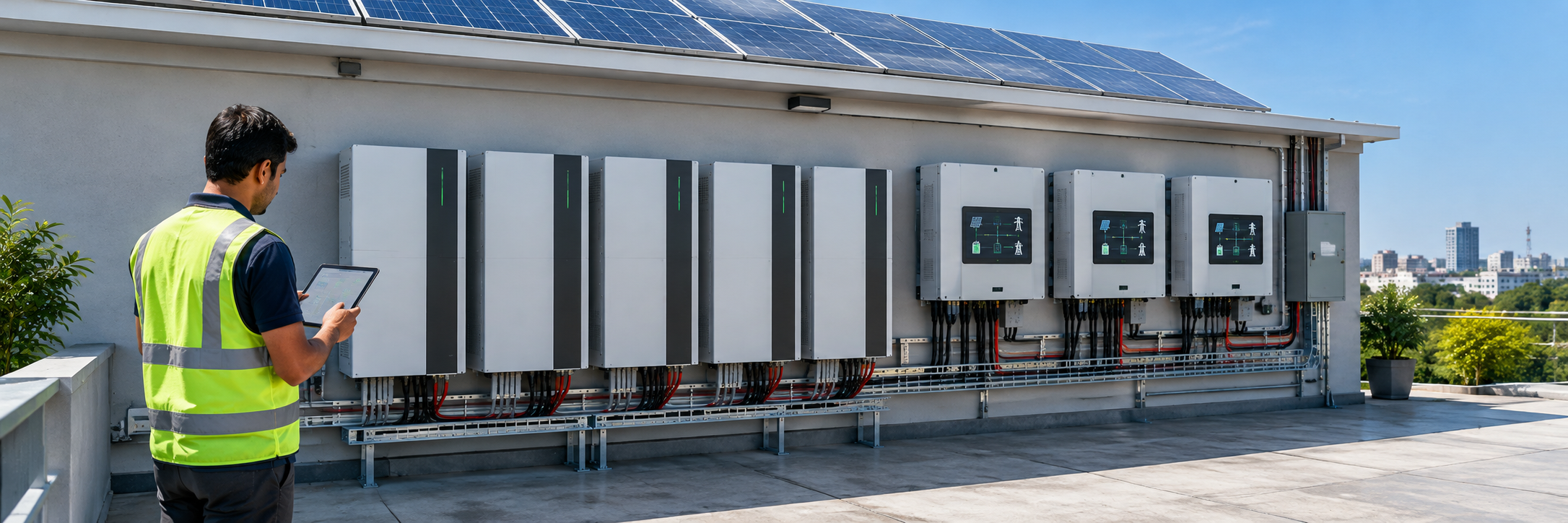
Consider a mid-sized commercial facility pairing a hybrid inverter with an LFP battery cabinet. During the day, the hybrid inverter directs surplus solar generation into the battery while running the facility's active loads directly from solar. In the evening, when grid tariffs rise during peak demand hours, the inverter draws from the stored battery charge instead of pulling expensive grid power. If the grid fails entirely, the same hybrid inverter switches to battery backup within milliseconds, keeping critical operations running without manual intervention, a single integrated system handling cost optimization, backup power, and grid compliance simultaneously.
The Practical Takeaway
A BESS and a hybrid inverter are not two separate purchases to evaluate independently, they are one coordinated energy system, and the quality of that coordination depends directly on certification, switchover speed, and battery chemistry. For any Indian homeowner or business evaluating innovative solar solutions with battery backup, the right questions are does the hybrid inverter carry valid BIS and IEC certification, does the battery meet IEC 62619 safety standards, and how fast does the system switch to backup power during a grid failure, because those three answers determine whether the investment delivers genuine energy resilience or just an expensive battery sitting mostly idle.