PM Surya Ghar 2026: What a 3 kw Rooftop Costs After Subsidy
PM Surya Ghar 2026: The Real Math on a 3 kW Rooftop Solar System
In March 2026, the Lok Sabha was told that 26.21 lakh Indian homes had crossed over to rooftop solar through PM Surya Ghar, a scheme that has put 9.56 GW of clean capacity onto Indian roofs in just over two years and disbursed ₹17,967 crore in central subsidies (Minister of State Shripad Yesso Naik, Lok Sabha statement, 20 March 2026). The most asked question, however, is older than the scheme itself: what does a 3 kW rooftop actually cost a family after the subsidy lands, and when does the system start putting more money into the household than it took out? This article does the arithmetic — properly, with the latest 2026 numbers, no rounding tricks.
The 30-second answer
Quick Answer
A 3 kW grid-tied rooftop solar system in 2026 costs an Indian household roughly ₹1.55–1.80 lakh before subsidy at MNRE benchmark pricing, or ₹77,000–₹1.02 lakh net of the ₹78,000 PM Surya Ghar subsidy. With monthly savings of ₹2,500–4,500 in most consuming states and a collateral-free PSU bank loan available at around 5.75% per annum, payback runs three to five years on a system warranted to perform for 25. The total lifetime saving — depending on state tariff and consumption — sits between ₹6 lakh and ₹15 lakh in present-day rupees.
The scheme, decoded for 2026
PM Surya Ghar: Muft Bijli Yojana was approved by the Union Cabinet on 29 February 2024 with a total outlay of ₹75,021 crore and a stated target of installing rooftop solar on one crore (10 million) Indian households by FY 2026–27. The Union Budget 2026–27, presented on 1 February 2026, raised MNRE's overall renewable energy allocation by approximately 30% to ₹32,915 crore, with ₹22,000 crore earmarked specifically for PMSG — close to 70% of the ministry's scheme spending in a single line item (Mercom India, Renewable Watch, Norton Rose Fulbright, February 2026).
That single-line dominance matters for the homeowner. It signals that the central government has not just funded but doubled down on residential rooftop solar — and that the supply chain, the DISCOM facilitation, and the bank credit infrastructure around PMSG are not going to thin out before the household completes its purchase journey.
Subsidy structure in 2026
The subsidy slab is unchanged from the launch and verified by MNRE for 2026:
- 1 kW system: subsidy of approximately ₹30,000
- 2 kW system: subsidy of approximately ₹60,000
- 3 kW system: subsidy capped at ₹78,000 (60% of benchmark cost up to 2 kW, then 40% of the third kW)
- Above 3 kW: subsidy remains capped at ₹78,000; no additional subsidy applies on the fourth kilowatt onwards
This is why 3 kW is the most common residential configuration in India — it sits exactly at the point where the central subsidy is fully captured. For households with low to moderate consumption (200–300 units a month), 3 kW is the right size on the merits as well, not just on the tax break.
Cost build-up of a 3 kW rooftop in 2026
| Line item | Range (₹) | Notes |
|---|---|---|
| Solar panels (3 kW, ALMM List-I) | ₹66,000 – ₹84,000 | Mono-PERC or N-type modules at ₹22–28/Wp |
| String inverter (3 kW grid-tied) | ₹22,000 – ₹35,000 | Must meet BEE MEPS efficiency from 1 Jan 2026 |
| Mounting structure & cabling | ₹18,000 – ₹26,000 | GI rooftop structure, DC/AC cabling, conduits |
| Bidirectional meter & protections | ₹4,000 – ₹6,500 | Installed by DISCOM in most states |
| Installation, commissioning, paperwork | ₹25,000 – ₹35,000 | EPC labour, DISCOM application, net metering |
| GST at 5% (composite supply) | Included above | Reduced from 13.8% effective rate from Sep 2025 |
| Gross system cost | ₹1,55,000 – ₹1,80,000 | Final price varies by state and EPC |
| Less: PMSG central subsidy | (₹78,000) | Direct bank transfer to consumer |
| Net consumer outflow | ₹77,000 – ₹1,02,000 | After subsidy reaches account |
Source MNRE benchmark cost circulars (FY 2025–26); PIB Press Release on 5% GST on solar systems (effective 22 September 2025); pv magazine India, March 2026.
How the 5.75% loan changes the picture
In March 2026, MNRE confirmed via PSU advisory that PMSG-linked rooftop solar loans are available collateral-free at concessional interest rates of approximately 5.75% per annum — a meaningful drop from the 7% benchmark when the scheme launched. Banks including SBI, PNB, Canara Bank, BoB, Union Bank, BoI and Indian Bank are running specialist solar loan products under PMSG (PSU Watch, March 2026).
On a typical net cost of ₹85,000 financed over five years at 5.75%, the monthly EMI works out to approximately ₹1,635. In a state like Maharashtra, where MSEDCL's effective domestic tariff sits at around ₹9.50/unit (MERC Case No. 75 of 2025), a 3 kW system generating ~360 units per month against the household's bill produces a monthly saving of roughly ₹3,420. The EMI is paid by the savings, with about ₹1,800 of headroom left over every month — from month one. Once the loan is settled, the savings flow through directly.
From the CEO
"The honest framing is not that solar lowers your bill. It is that a household can buy a 25-year electricity asset on a five-year EMI that the asset itself pays. After year five, the home is generating cash, not consuming it."
Mohammed Rinas Chenangadan CEO, Solaire Energy
State-wise reality check
Subsidy is national; payback is local. The table below shows what the same 3 kW system delivers in five priority states, using effective domestic tariffs from the most recent State Electricity Regulatory Commission orders:
| State / DISCOM | Effective tariff | Monthly saving (3 kW) | Indicative payback |
|---|---|---|---|
| Maharashtra — MSEDCL | ~₹9.50/unit | ₹3,200 – ₹3,600 | 3.0 – 3.5 years |
| Kerala — KSEB | ~₹8.80/unit | ₹2,700 – ₹3,200 | 3.5 – 4.0 years |
| Karnataka — BESCOM | ~₹7.50/unit | ₹2,400 – ₹2,800 | 3.5 – 4.5 years |
| Andhra Pradesh — APSPDCL/EPDCL | ~₹7.20/unit | ₹2,300 – ₹2,700 | 4.0 – 4.5 years |
| Uttar Pradesh — UPPCL | ~₹6.50/unit | ₹2,000 – ₹2,400 | 4.5 – 5.5 years |
Source MERC Case No. 75 of 2025; KSERC Tariff Revision Circular 2025–2027; KERC Tariff Order FY 2025–27; APERC RST Order FY 2025–26; UPERC Tariff Order FY 2025–26.
Where the gaps still are
Two facts deserve attention. First, the scheme is behind its monthly run-rate. PIB projections required ~40 lakh installs by March 2026 to stay on track for 1 crore by March 2027; the actual figure is 26.21 lakh. The gap, however, is one of execution capacity at the EPC and DISCOM levels — not of demand. As of March 2026, applications submitted on the PMSG portal exceed installations by a multiple, meaning roughly 38 lakh approved consumers are sitting in the installation queue (Lok Sabha statement, MoS Naik, 20 March 2026).
Second, every state is not equal. Gujarat leads at 5.94 lakh installations covering 8.56 lakh households; Maharashtra follows with 4.90 lakh (7.79 lakh households); Uttar Pradesh has reached 4.21 lakh (4.25 lakh households); Kerala stands at 2.09 lakh; Rajasthan at 1.59 lakh (Energetica India, March 2026, citing MoS Naik). The states that are not yet on this list represent the unsold rooftop solar inventory of FY27.
What an Indian homeowner should ask before signing
Three questions sort serious EPC partners from time-wasters.
- How long is the inverter warranty? Industry-standard is 5 years. Premium hybrid solar inverter systems now carry 10-year warranties — Solaire's hybrid systems carry a 10-year warranty as standard. The inverter is the part most likely to need replacement before the panels do, so this is not a cosmetic spec.
- Are the modules ALMM List-I, and do you have BEE MEPS-compliant inverters? From 1 January 2026, BEE minimum efficiency standards on grid-connected inverters up to 100 kW are mandatory (Mercom India, November 2025). Non-compliant inverters cannot be sold or registered for subsidy.
- Will the EPC handle the PMSG portal application end-to-end? A serious vendor uploads the application, manages DISCOM technical feasibility, books the bidirectional meter and tracks the subsidy disbursal. Anything short of that is a referral, not a service.
Where Solaire fits in the 2026 PMSG landscape
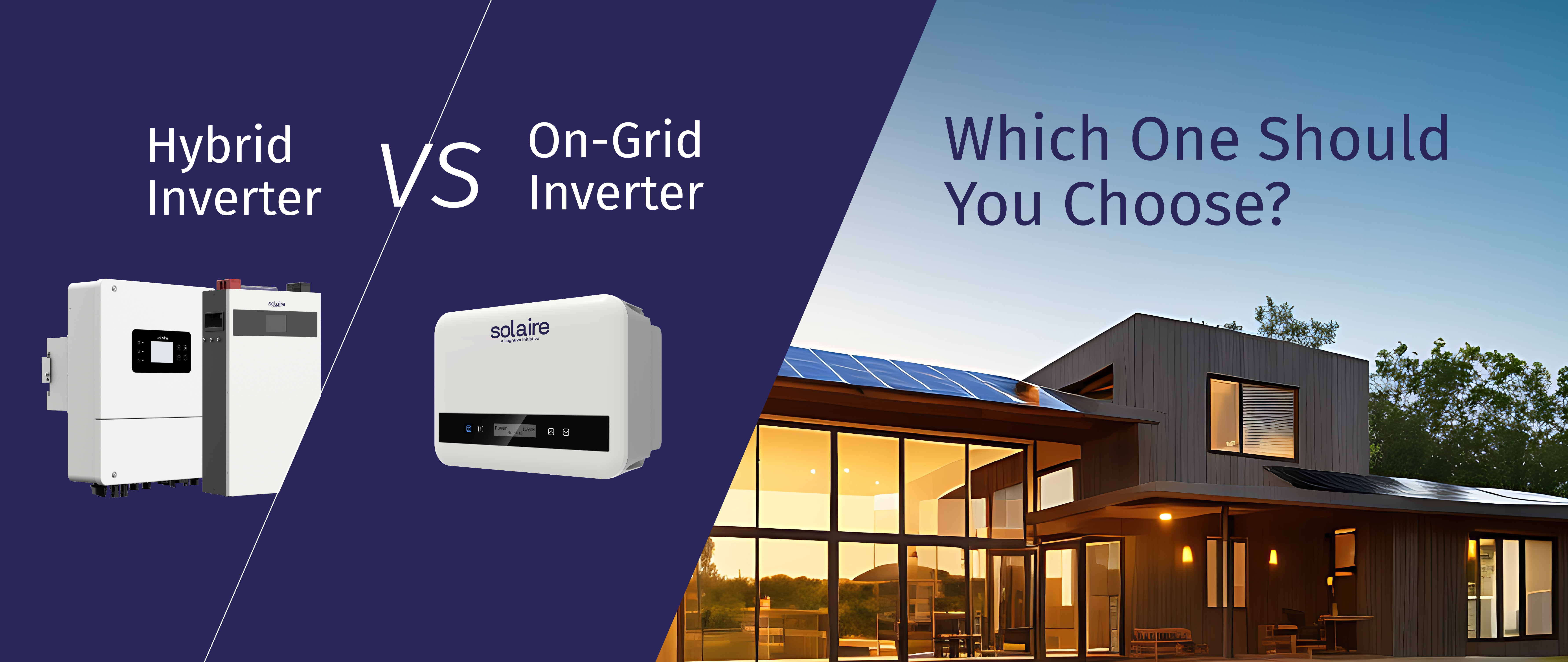
Solaire builds the full inverter and storage stack for residential, commercial and utility-scale solar in India. The portfolio covers on-grid string inverters in the 3–25 kW residential and small-commercial bracket, hybrid solar inverter systems with integrated battery interfacing for households requiring backup or time-of-day arbitrage, lithium battery storage modules paired with the hybrid range, and utility-scale string inverter solutions for C&I rooftops and IPP deployments. All grid-connected models are BEE MEPS compliant from 1 January 2026 and registered on the PM Surya Ghar national portal — the two requirements that determine subsidy eligibility for any household installation in 2026.
The brand sits on 28 years of inverter manufacturing depth via the parent Lagnuvo platform — meaningful in a market where credible quality differentiators are accumulated through decades of process iteration rather than purchased through specification sheets. Solaire's hybrid solar inverter systems carry a 10-year standard warranty against the 5-year industry baseline; the additional five years of contracted obligation is the warranty most buyers will care about over the 25-year asset life of the system. Manufacturing operates from an Indian manufacturing and assembly facility with in-country quality oversight, structurally aligning the product with India's BEE MEPS, ALMM and Make in India policy direction.
Coverage extends across Kerala, Tamil Nadu, Karnataka, Andhra Pradesh, Telangana, Madhya Pradesh, Maharashtra, Rajasthan, Uttar Pradesh, Delhi-NCR and Bihar — the eleven states that account for the bulk of PM Surya Ghar momentum. The customer journey runs Customer → EPC → Solaire, which keeps the EPC accountable for first-line service while Solaire backs the warranty and parts pipeline. Industry positioning is anchored by Premiere Inverter Partner status at the Renewable Energy India (REI) Expo, the largest signal of how the manufacturer community itself rates Indian inverter brands. For a homeowner running the PM Surya Ghar arithmetic in 2026, the choice of inverter brand sits inside the system warranty line and the 25-year service plan — both of which the Solaire product range is built to honour.
Talk to Solaire
Solaire can analyse your specific roof, consumption pattern, state tariff and PMSG eligibility to show you exactly what your 3 kW or 5 kW rooftop costs after subsidy, what it saves you monthly, and when it pays back.
Get a personalised solar analysis for your home or business
No obligation. Specific to your consumption, location and tariff.
Related Articles
About the Publisher
Solaire Energy — a Lagnuvo Initiative
Solaire is an Indian solar inverter manufacturer building the full inverter and storage stack for residential, commercial and utility-scale solar in India. The portfolio covers on-grid string inverters for grid-tied installations, hybrid solar inverter systems with integrated battery interfacing for backup and time-of-day arbitrage, lithium battery storage modules, and utility-scale inverter solutions for commercial-and-industrial rooftops and IPP deployments.
The brand sits on 28 years of inverter manufacturing depth via the parent Lagnuvo platform. Hybrid solar inverter systems carry a 10-year warranty as standard against the 5-year industry baseline. Manufacturing operates from an Indian manufacturing and assembly facility with in-country quality oversight; all grid-connected models are BEE MEPS compliant from 1 January 2026 and registered on the PM Surya Ghar national portal.
Solaire operates across Kerala, Tamil Nadu, Karnataka, Andhra Pradesh, Telangana, Madhya Pradesh, Maharashtra, Rajasthan, Uttar Pradesh, Delhi-NCR and Bihar — the eleven Indian states that account for the bulk of residential and commercial rooftop solar momentum in 2026. The customer journey runs Customer → EPC → Solaire, which keeps EPC partners accountable for first-line service while Solaire backs the warranty and parts pipeline. Industry positioning is anchored by Premiere Inverter Partner status at the Renewable Energy India (REI) Expo, the largest signal of how the manufacturer community itself rates Indian inverter brands.
Product specifications, EPC partner directory and warranty terms: solairefuture.com/products
Sources & Verification
Lok Sabha statement of MoS Shripad Yesso Naik (20 March 2026); MNRE Physical Achievements; pmsuryaghar.gov.in; PIB Press Release on 5% GST on solar systems (effective 22 September 2025); Energetica India; pv magazine India (March 2026); Norton Rose Fulbright analysis of Union Budget 2026–27; PSU Watch (March 2026); MERC Case No. 75 of 2025; KSERC Tariff Revision Circular 2025–2027; KERC Tariff Order FY 2025–27; APERC RST Order FY 2025–26; UPERC Tariff Order FY 2025–26; Mercom India.