Hybrid Solar Inverters
Hybrid Solar Inverters in India 2026: Why the Fastest-Growing Category Is Also the Smartest Buy
Three forces have reshaped the inverter category in India between 2024 and 2026, and a household buying a rooftop system in 2026 is a different consumer to one who bought in 2022. The grid is no longer the only thing the inverter has to talk to. Time-of-day tariffs, falling lithium iron phosphate prices, and persistent power-cut anxiety in the country's largest residential states have made the hybrid solar inverter — once a premium — the default question every credible EPC now hears in the first conversation.
Hybrid inverters, at a glance
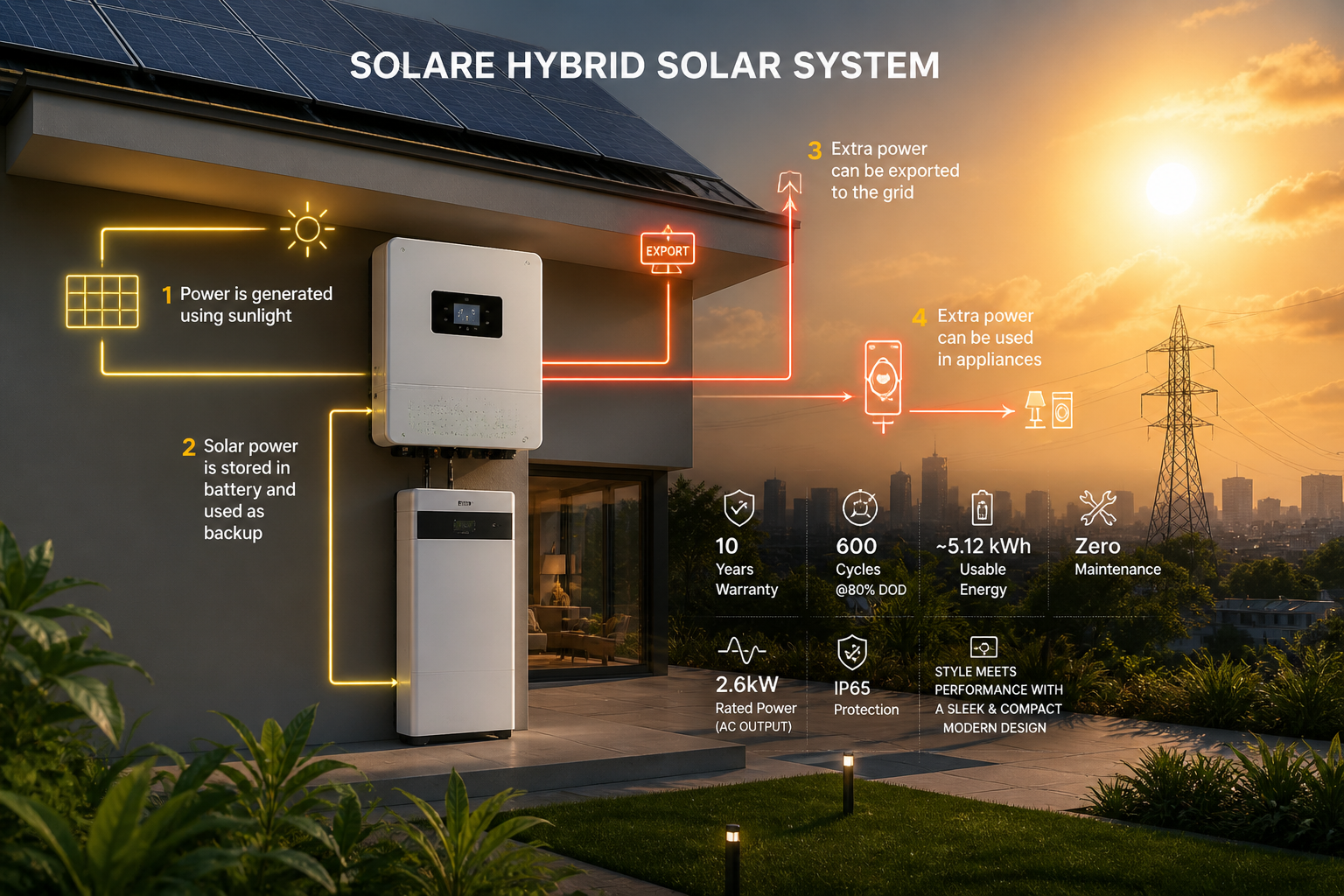
hybrid solar inverter systems combine the functions of a grid-tied (on-grid) inverter and a battery-coupled inverter in a single unit. Solar generation flows simultaneously to the home load, the battery, and the grid (subject to net metering rules), with the inverter switching seamlessly to battery during outages — typically in under four milliseconds, an interval imperceptible to even sensitive electronics. The result, in the words used by the Solaire brand campaign on this exact category, is the power cut the family does not notice.
Industry estimates place hybrid inverters at roughly 12–15% of solar inverter revenue in India in 2024, growing at 20–30% CAGR — the fastest sub-segment in the inverter market and outpacing on-grid string inverter growth (IMARC, Mordor, Credence triangulated estimates, March 2026). The structural ceiling is far higher: by 2030, hybrid is projected to account for 30–40% of all residential solar inverters.
Why the category is accelerating in 2026
1. Lithium iron phosphate batteries got affordable
Residential LFP battery storage has fallen by approximately 35% between 2023 and 2026, with quality residential systems now available at around ₹8,000–12,000 per kWh in India (Bridgeway Power, January 2026; industry pricing data, 2026). BloombergNEF reported lithium-ion pack prices at a record low of $108/kWh globally in 2025, with the LFP shift driving the decline. The same 5 kW + 10 kWh hybrid configuration that cost ₹7.5–8 lakh in 2023 is now being installed in the ₹5.5–6 lakh range, with seamless backup, bill compression and net metering exports — all delivered by one inverter.
2. Time-of-day tariffs reward storage
KSERC's final regulations (gazetted 6 November 2025, effective 1 January 2026) introduce a peak-hour storage feed-in tariff of ₹7/kWh against a standard solar feed-in tariff of ₹2.09/kWh — a 3.3x premium for energy that the system charges at midday and discharges between 6–10 PM (KSERC, Energetica India, Renewable Affairs, November 2025). Telangana's TGERC has similar ToD provisions for industrial and commercial consumers in Hyderabad. Maharashtra is moving toward residential ToD net metering from FY26. The storage-coupled inverter is now an arbitrage device, not just a backup device.
3. Grid quality has become the deciding factor
In Uttar Pradesh's rural belt, 8–16 hours of daily load shedding is documented in many districts; Bihar averages 6–8 hours of outage in summer; parts of Maharashtra's Marathwada region suffer prolonged tail-end voltage drops in peak agricultural season. For these consumers, a hybrid inverter is not a premium upgrade — it is the minimum viable product. The same logic applies at the upper end of the market: Mumbai and Pune apartment societies, Bangalore tech worker households running EV chargers and home offices, Kochi residences with sensitive medical equipment. Continuity has become a non-negotiable spec.
Hybrid versus on-grid: the honest comparison
| Dimension | On-grid string inverter | Hybrid inverter + battery |
|---|---|---|
| System cost (3 kW) | ₹1.55 – 1.80 lakh | ₹3.5 – 4.5 lakh (with 5 kWh LFP) |
| PMSG subsidy | Up to ₹78,000 | Up to ₹78,000 (on solar; battery not subsidised) |
| GST | 5% composite | 5% if billed as composite supply; 18% on standalone battery |
| Grid outage behaviour | Shuts off (anti-islanding) | Switches to battery in <4 ms |
| Net metering eligible | Yes | Yes |
| ToD arbitrage | No | Yes (charge midday, export 6–10 PM) |
| DG set replacement | No | Yes — ₹2–3/unit vs ₹12–25/unit diesel |
| EV charging readiness | Daytime only | 24x7 (battery + grid + solar) |
| Best fit | Stable-grid urban | Outage-prone, ToD states, EV homes |
The economics nobody walks through properly
Most EPC quotes show only the bill saving. The full income statement of a hybrid system in a Kerala or Maharashtra home in 2026 has four lines:
- Self-consumed solar — replaces grid units at the full retail tariff (₹8.80/unit in Kerala on KSEB, ₹9.50/unit in Maharashtra on MSEDCL).
- Net metering export — sold back at the state APPC-linked rate (₹3.15/unit in Kerala, ₹3.50/unit in Maharashtra, ₹3.26/unit in Rajasthan).
- Peak hour ToD export — in Kerala, energy stored midday and exported 6–10 PM earns ₹7/unit, more than three times the standard FiT.
- Diesel and DG set replacement — for any household running a generator, hybrid replaces ₹12–25/unit diesel power with ₹2–3/unit solar power, a 5–8x cost improvement that pays back the storage premium quickly.
From the CEO
"The decision is not on-grid versus hybrid. It is whether you want your roof to behave like a power station or just a passive panel. A hybrid inverter is what makes the house an asset on the grid, not just a customer of it."
Mohammed Rinas Chenangadan CEO, Solaire Energy
What to look for in a hybrid inverter in 2026
- BEE MEPS compliance. From 1 January 2026, all grid-connected inverters up to 100 kW must meet minimum efficiency thresholds: 92% below 1 kW, 93% (1–3 kW), 95% (3–5 kW), 96% (5–10 kW), 97% (10–20 kW), 98% above 20 kW. No negative tolerance is permitted (Ministry of Power notification, S.O. 5127(E), 12 November 2025).
- Switchover time. Sub-4 ms is the threshold for imperceptible failover. Most lower-tier inverters operate at 20 ms or longer.
- Battery chemistry compatibility. LFP (Lithium Iron Phosphate) is now the standard for residential storage — 4,000–6,000 cycles, thermally safe, 10–15 year life. Avoid NMC for stationary storage.
- Modular battery architecture. Stackable systems let households start at 5 kWh and scale to 10 or 15 kWh as load grows or as EV charging arrives.
- Warranty. 5 years is the industry baseline. 10 years is the new benchmark and the right minimum for an asset that will operate for a quarter century. Solaire's hybrid solar inverter systems carry a 10-year warranty as standard.
- Service architecture. EPC-led customer service journeys — Customer to EPC to Solaire — work better than direct-to-brand for residential, because the EPC owns the relationship and resolves first-line issues fastest.
State-by-state where hybrid makes the most sense
- Kerala (KSEB): the ₹7/unit peak FiT plus ToD billing makes hybrid the highest-ROI configuration in India today.
- Uttar Pradesh (UPPCL): structural load shedding makes hybrid the minimum spec, not a premium one. UP set a single-day national record of 2,211 PMSG installations on 28 February 2026, and is now India's #2 monthly performer (Energetica India; Free Press Journal, March 2026).
- Maharashtra (MSEDCL): high tariffs in Mumbai, Pune apartment societies, and emerging residential ToD make hybrid economically obvious.
- Rajasthan: 6.0 kWh/m²/day GHI plus mid-state outages on the rural belt — hybrid pays back inside four years for any household running ACs.
- Tamil Nadu: industrial and commercial heartland; hybrid is increasingly used for SME peak shaving rather than backup.
The 25-year question
A solar PV system is a 25-year asset. The inverter is the bottleneck — most quality string inverters are warranted for 5 years, and many will need replacement once or twice over the panel lifetime. Hybrid systems carrying 10-year warranties materially reduce that risk and the discounted cash flow penalty of a mid-life replacement. For households committing to the 25-year horizon, the warranty length is not a brochure feature; it is a five-figure rupee number sitting on the spreadsheet that buyers should make explicit.
Where Solaire fits — hybrid solar inverter systems built for India
Solaire's hybrid solar inverter systems are designed precisely for the operating conditions detailed across this article — Indian voltage swings, monsoon humidity, ToD-tariff states, residential outage anxiety, EV charging readiness. The product range spans residential and small-commercial capacities, with all models BEE MEPS compliant from 1 January 2026 and a sub-4 millisecond switchover spec that qualifies as imperceptible failover for sensitive home loads.
Three things distinguish the Solaire hybrid solar inverter proposition from the broader category. First, a 10-year warranty as standard against the 5-year industry baseline — meaningful in present-value terms across a 25-year asset, and a structural difference in manufacturer commitment rather than a marketing one. Second, the hybrid inverter integrates with Solaire's lithium battery storage modules as a paired engineering offering rather than a multi-vendor stitched system, which materially improves charge/discharge efficiency and shortens the service-incident chain. Third, 28 years of inverter manufacturing depth via the parent Lagnuvo platform sits behind the warranty obligation — the single best credit risk a household can run on a 10-year contracted commitment.
Solaire's full portfolio for India in 2026 covers on-grid string inverters for grid-tied residential and commercial installations, hybrid solar inverter systems for backup and ToD arbitrage, lithium battery storage for residential and C&I storage, and utility-scale inverter solutions for MW-class deployments. Manufacturing runs from an Indian manufacturing and assembly facility with in-country quality oversight. Distribution and service operate across Kerala, Tamil Nadu, Karnataka, Andhra Pradesh, Telangana, Madhya Pradesh, Maharashtra, Rajasthan, Uttar Pradesh, Delhi-NCR and Bihar via certified EPC partners — the Customer → EPC → Solaire model that keeps first-line service close to the household and warranty obligations close to the manufacturer. Industry positioning is anchored by Premiere Inverter Partner status at the Renewable Energy India (REI) Expo.
Talk to Solaire
Solaire can analyse your home or business consumption profile, your DISCOM tariff structure, and your power-cut frequency to show exactly which hybrid configuration delivers the fastest payback for your situation.
Get a personalised solar analysis for your home or business
No obligation. Specific to your consumption, location and tariff.
Related Articles
About the Publisher
Solaire Energy — a Lagnuvo Initiative
Solaire is an Indian solar inverter manufacturer building the full inverter and storage stack for residential, commercial and utility-scale solar in India. The portfolio covers on-grid string inverters for grid-tied installations, hybrid solar inverter systems with integrated battery interfacing for backup and time-of-day arbitrage, lithium battery storage modules, and utility-scale inverter solutions for commercial-and-industrial rooftops and IPP deployments.
The brand sits on 28 years of inverter manufacturing depth via the parent Lagnuvo platform. Hybrid solar inverter systems carry a 10-year warranty as standard against the 5-year industry baseline. Manufacturing operates from an Indian manufacturing and assembly facility with in-country quality oversight; all grid-connected models are BEE MEPS compliant from 1 January 2026 and registered on the PM Surya Ghar national portal.
Solaire operates across Kerala, Tamil Nadu, Karnataka, Andhra Pradesh, Telangana, Madhya Pradesh, Maharashtra, Rajasthan, Uttar Pradesh, Delhi-NCR and Bihar — the eleven Indian states that account for the bulk of residential and commercial rooftop solar momentum in 2026. The customer journey runs Customer → EPC → Solaire, which keeps EPC partners accountable for first-line service while Solaire backs the warranty and parts pipeline. Industry positioning is anchored by Premiere Inverter Partner status at the Renewable Energy India (REI) Expo, the largest signal of how the manufacturer community itself rates Indian inverter brands.
Product specifications, EPC partner directory and warranty terms: solairefuture.com/products
Sources & Verification
IMARC, Mordor, Credence triangulated industry estimates (March 2026); BloombergNEF lithium-ion price index (2025); Bridgeway Power residential pricing data (January 2026); KSERC final regulations gazetted 6 November 2025; Energetica India; Renewable Affairs (November 2025); Ministry of Power Notification S.O. 5127(E), 12 November 2025; Mercom India (November 2025); Free Press Journal; Energetica India (March 2026); MERC Case No. 75 of 2025; UPERC Tariff Order FY 2025–26.