Net Metering in India 2026
Net Metering in India 2026: The State-by-State Guide for Rooftop Solar Owners
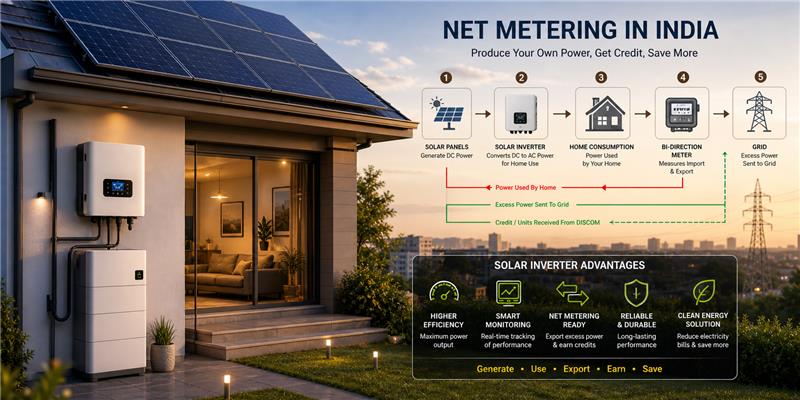
Net metering is the contract that turns a rooftop solar system from a personal generator into a bidirectional partner of the grid. In 2026, every Indian state runs net metering — but no two states run it the same way. The capacity limits, the buy-back rates, the settlement period, and the type of metering (net, gross, group, virtual) vary significantly across DISCOMs, and the wrong assumption at the design stage can compress a system's lifetime ROI by 15–25%. This guide walks through what is true in 2026 and where the 2025–26 changes have moved the needle for households and small businesses.
The four metering models in plain English
- Net Metering: the system exports surplus to the grid; export units offset import units in the bill at retail tariff. Simple, automatic, residential-default. Most states cap residential at 10–500 kW; Kerala recently raised the domestic cap to 20 kW.
- Net Billing: export and import are metered and priced separately. Export earns a feed-in tariff (FiT, typically lower than retail); import is billed at retail. More granular, more state control, increasingly common for C&I.
- Gross Metering: 100% of generation flows to the grid at a fixed FiT; the home pays the full retail bill. Used in some industrial schemes; rarely beneficial for residential.
- Group / Virtual Net Metering (GNM/VNM): credits aggregated across multiple meters of the same consumer (VNM) or shared across a society (GNM). Available in Delhi, Rajasthan, Karnataka, UP, MP — particularly useful for apartment buildings.
State-by-state status — verified, March 2026
| State / DISCOM | Capacity limit (domestic) | Buy-back / FiT | Latest tariff order |
|---|---|---|---|
| Kerala — KSEB | 20 kW (raised from draft 3 kW) | APPC ₹3.08; std FiT ₹2.09; peak ₹7/kWh with storage | KSERC final regs gazetted 6 Nov 2025, eff. 1 Jan 2026 |
| Maharashtra — MSEDCL | Up to 5 MW (C&I); residential standard | ₹3.50/unit | MERC Case No. 75 of 2025; eff. 1 Jul 2025 |
| Uttar Pradesh — UPPCL | Up to 500 kW (gross/net); VNM available | ₹3.00/unit | UPERC Tariff Order FY 2025–26 |
| Karnataka — BESCOM | 10 kW (residential); 50 kW (C&I) | ₹3.00/unit | KERC Tariff Order FY 2025–27 |
| Tamil Nadu — TANGEDCO | 500 kW; tech feasibility waived ≤10 kW | ₹2.50/unit | TNERC SMT.No.6 of 2025 |
| Andhra Pradesh — APSPDCL/EPDCL | 1 MW | ₹3.20/unit | APERC RST FY 2025–26 (frozen) |
| Telangana — TSSPDCL/NPDCL | 500 kW NM; 1 MW gross; ToD applicable | ₹3.00/unit | TGERC FY 2025–26 (flat) |
| Rajasthan — JVVNL/AVVNL | MW-scale; no wheeling charges for RTS | ₹3.26 (NM) / ₹3.65 (NB) | RERC FY 2024–25; revised Oct 2025 |
| Gujarat — DGVCL/UGVCL | Up to 1 MW residential | ₹2.80/unit | GERC MYT 2024 (Apr 2025), retained FY26 |
| Delhi — BSES/TPDDL | NM + GNM + VNM (group housing) | ₹3.00/unit | DERC FY 2025–26 |
| Madhya Pradesh | 500 kW (incl. GNM/VNM) | APPC-linked | MPERC 2024 regulations |
Source SERC orders cited above (KSERC, MERC, UPERC, KERC, TNERC, APERC, TGERC, RERC, GERC, DERC, MPERC); SolarQuarter; pv magazine India; Mercom India; Renewable Affairs; Energetica India (compiled February–March 2026).
The Kerala 2026 reset
KSERC's final regulations, gazetted on 6 November 2025 with billing effective 1 January 2026, are the single most consequential rooftop solar regulation passed in India in the last cycle. The draft of May 2025 had proposed a 3 kW cap on net metering for domestic consumers — a number that would have crippled the residential category. The final gazette restored the cap to 20 kW for domestic and added an industry-leading peak-hour storage FiT of ₹7/kWh between 6 PM and 10 PM (Renewable Affairs, Energetica India, KSERC; November 2025).
The registration fee for new rooftop systems was simultaneously reduced from ₹1,000/kW to ₹300/kW, with the approval window fast-tracked to 15 days. For Kerala households and EPCs, this is the most attractive net metering regime in India. For Solaire, whose hybrid solar inverter systems are designed precisely for the storage-arbitrage opportunity that KSERC has now formalised, it is also a structural validation.
The Maharashtra net metering hold
In December 2025, the Maharashtra Electricity Regulatory Commission upheld net metering rights for consumers operating alongside open access — closing a long-running ambiguity for C&I consumers. MSEDCL's effective domestic tariff at approximately ₹9.50/unit (MERC Case No. 75 of 2025), combined with a stable ₹3.50 buy-back rate, makes Maharashtra the highest-ROI mainstream state for residential rooftop solar in India today. Maharashtra also reported 162.3% YoY rooftop solar growth in 9M 2025 and added 1,227 MW of RTS in FY2025 — the second-highest in the country (Mercom India, December 2025).
Uttar Pradesh: the volume story
UP is now India's #2 PMSG performer by monthly installations as of January–February 2026, with a single-day national record of 2,211 installations on 28 February 2026. The state generates approximately ₹20–25 crore of daily economic activity in the solar sector, with 4,500+ active EPC vendors and 60,000+ people employed in the rooftop solar value chain (Free Press Journal, March 2026). UPPCL net metering is operational and approvals are processed in 3–6 weeks in most circles. The economics of rooftop solar in UP are not driven by tariff (₹6.50/unit is mid-range nationally) but by the scale of unmet residential demand and the structural reliability deficit that makes hybrid inverters effectively the default.
Common net metering mistakes that hurt ROI
- Sizing the system to maximum subsidy rather than household consumption profile. A 3 kW system on a 100-unit-a-month home exports most of its output at the lower buy-back rate; a 2 kW system would have offset all the home's bills at retail.
- Ignoring the retail-versus-FiT spread. Self-consumed solar replaces ₹8–10/unit grid power; exported solar earns ₹2.50–3.50/unit. The system is significantly more valuable when consumed than exported. Hybrid systems with battery storage capture more of this spread.
- Missing the ToD arbitrage where it exists. In Kerala (and increasingly Maharashtra and Telangana), the ₹7/kWh peak FiT against ₹2.09 standard FiT is a 3.3x premium for energy that is effectively shifted by the battery — entirely missed by on-grid systems.
- Not registering on the PM Surya Ghar national portal. DISCOM connection without PMSG registration costs the household ₹78,000 in subsidy and the loan rate falls outside the 5.75% concessional window.
The MNRE 2021 framework, in 2026
The MNRE Net Metering Regulations 2021 mandate net metering for all rooftop solar systems up to 500 kW connected to LT or HT networks, with a banking period of typically 12 months and bidirectional metering installed by the DISCOM (cost ₹1,500–₹3,500). State commissions have discretion above the 500 kW threshold and on FiT levels. A handful of states (notably Tamil Nadu and Rajasthan) have introduced state-specific deviations — bimonthly billing in Tamil Nadu, the higher ₹3.65 net billing rate in Rajasthan — but the underlying right to net metering for residential rooftop solar is national and stable.
From the CEO
"Net metering is a contract between the home and the grid. The job of the inverter — and of a serious manufacturer — is to make sure that contract gets honoured every day for 25 years, in every voltage condition the grid throws at it."
Mohammed Rinas Chenangadan CEO, Solaire Energy
What this means for a 2026 buyer
Three practical takeaways:
- Choose your system size for your consumption, not your subsidy ceiling. A right-sized 2 kW or 3 kW system that offsets most of the home's bill at retail outperforms an oversized one that exports at low FiT.
- In Kerala, Maharashtra or Telangana, default to hybrid. ToD economics and the peak-hour FiT structurally favour storage. The payback on the additional battery cost is shorter than commonly assumed.
- Confirm DISCOM empanelment of your installer in writing. Each state runs separate empanelment — KSEB in Kerala, MSEDCL in Maharashtra, UPPCL in UP, and so on. The PMSG subsidy and the net metering connection both depend on installer-side empanelment.
Where Solaire fits — inverters built for Indian net metering
Net metering is a contract that an inverter has to honour every day for 25 years. The inverter spec sheet — anti-islanding, voltage range tolerance, frequency drift handling, harmonic distortion limits — is the engineering layer that determines whether the contract holds up under the everyday voltage swings of an Indian DISCOM connection. Solaire's on-grid string inverters and hybrid solar inverter systems are designed against precisely these conditions, with BEE MEPS compliance certified from 1 January 2026 and PMSG-portal registration that makes them subsidy-eligible at the household level.
For Kerala buyers in particular — where KSERC's January 2026 ToD framework introduces the ₹7/kWh peak feed-in tariff for storage-coupled systems — Solaire's hybrid solar inverter systems paired with lithium battery storage are designed to capture exactly the midday-charge / evening-discharge arbitrage the regulation has formalised. For Maharashtra buyers, where MSEDCL's effective ₹9.50/unit retail tariff combined with the stable ₹3.50 buy-back rate makes self-consumption a much more valuable use of solar than export, Solaire's on-grid string inverters at right-sized residential capacities are the configuration that maximises bill offset. For UP buyers facing structural load shedding alongside net metering, the hybrid solar inverter system with integrated lithium battery storage replaces both the grid (during outages) and the diesel generator (with a 5–8x cost improvement per unit) — a use case that on-grid systems cannot serve.
The full Solaire product range in 2026 covers on-grid string inverters, hybrid solar inverter systems, lithium battery storage and utility-scale inverter solutions, all backed by 28 years of inverter manufacturing depth, an Indian manufacturing and assembly facility, a 10-year warranty on hybrid systems against the 5-year industry baseline, and Premiere Inverter Partner status at the Renewable Energy India (REI) Expo. The brand operates across Kerala, Tamil Nadu, Karnataka, Andhra Pradesh, Telangana, Madhya Pradesh, Maharashtra, Rajasthan, Uttar Pradesh, Delhi-NCR and Bihar through certified EPC partners on the Customer → EPC → Solaire service model.
Talk to Solaire
Solaire can analyse your DISCOM tariff structure, your net metering eligibility, and the right system size and configuration for your state — whether you're in a ToD state like Kerala, a high-tariff state like Maharashtra, or an outage-prone state like UP.
Get a personalised solar analysis for your home or business
No obligation. Specific to your consumption, location and tariff.
Related Articles
About the Publisher
Solaire Energy — a Lagnuvo Initiative
Solaire is an Indian solar inverter manufacturer building the full inverter and storage stack for residential, commercial and utility-scale solar in India. The portfolio covers on-grid string inverters for grid-tied installations, hybrid solar inverter systems with integrated battery interfacing for backup and time-of-day arbitrage, lithium battery storage modules, and utility-scale inverter solutions for commercial-and-industrial rooftops and IPP deployments.
The brand sits on 28 years of inverter manufacturing depth via the parent Lagnuvo platform. Hybrid solar inverter systems carry a 10-year warranty as standard against the 5-year industry baseline. Manufacturing operates from an Indian manufacturing and assembly facility with in-country quality oversight; all grid-connected models are BEE MEPS compliant from 1 January 2026 and registered on the PM Surya Ghar national portal.
Solaire operates across Kerala, Tamil Nadu, Karnataka, Andhra Pradesh, Telangana, Madhya Pradesh, Maharashtra, Rajasthan, Uttar Pradesh, Delhi-NCR and Bihar — the eleven Indian states that account for the bulk of residential and commercial rooftop solar momentum in 2026. The customer journey runs Customer → EPC → Solaire, which keeps EPC partners accountable for first-line service while Solaire backs the warranty and parts pipeline. Industry positioning is anchored by Premiere Inverter Partner status at the Renewable Energy India (REI) Expo, the largest signal of how the manufacturer community itself rates Indian inverter brands.
Product specifications, EPC partner directory and warranty terms: solairefuture.com/products
Sources & Verification
KSERC final regulations gazetted 6 November 2025; MERC Case No. 75 of 2025; UPERC Tariff Order FY 2025–26; KERC Tariff Order FY 2025–27; TNERC SMT.No.6 of 2025; APERC RST FY 2025–26; TGERC FY 2025–26; RERC FY 2024–25 (revised October 2025); GERC MYT 2024 (April 2025); DERC FY 2025–26; MPERC 2024 regulations; SolarQuarter; pv magazine India; Mercom India; Renewable Affairs; Energetica India (compiled February–March 2026); Free Press Journal (March 2026); MNRE Net Metering Regulations 2021.