How Does Utility-Scale Solar Inverters Keep MW-Scale Plants Stable
How Does Utility-Scale Solar Inverters Keep MW-Scale Plants Stable
What Are Utility-Scale Solar Inverters?
A utility-scale solar inverter is an industrial-grade power conversion device that transforms DC electricity from solar panels into AC electricity compatible with the electrical grid. Unlike residential inverters (2-10 kW), utility scale inverters are massive systems – typically 75-350 kW each – installed in MW-scale solar plants that connect directly to transmission or sub-transmission grids.
A 50 MW solar park doesn't use one giant inverter. Instead, it uses 50-100 utility scale solar inverters working in parallel, collectively managing the conversion of all solar generation.
The Problem: Grid Stability at MW Scale
Why MW-Scale Solar is Different
When a 50 MW solar plant connects to the grid, it becomes a major power source in that region. Its generation directly impacts grid frequency, voltage at nearby substations, and overall system stability. This is fundamentally different from residential solar. A 5 kW home system failing has no measurable grid impact. A 50 MW plant failing can black out an entire district.
The Stability Challenge
Grid operators (SLDCs) maintain two critical parameters: frequency must stay within 49.5-50.5 Hz, and voltage must remain within ±10% of nominal. When either drifts outside safe limits, grid instability cascades – motors stall, transformers overheat, protective relays trip, and blackouts spread.
The Solar Challenge: Solar generation is intermittent. When clouds pass over a 50 MW plant, output can drop 1-5 MW per second. This sudden loss destabilizes frequency instantly. Grid must respond within 100-200ms or frequency collapses. Traditional plants respond naturally; solar plants require electronic intervention.
Why Utility Scale Inverters Exist: The Solution to an Unprecedented Problem
The Historical Context
When solar was <1% of grid capacity, this wasn't a problem. A few small plants had minimal grid impact. But as solar penetration has reached 10-15% in some regions (and growing), the grid stability problem became acute. Grid operators faced a choice: reject all new solar installations or develop technology that allows solar to stabilize the grid like traditional generation. Utility scale solar inverters were the solution.
Utility-scale inverters were the solution. They're designed to do something unprecedented: replace the natural stability properties of traditional generators with electronic control and rapid power response.
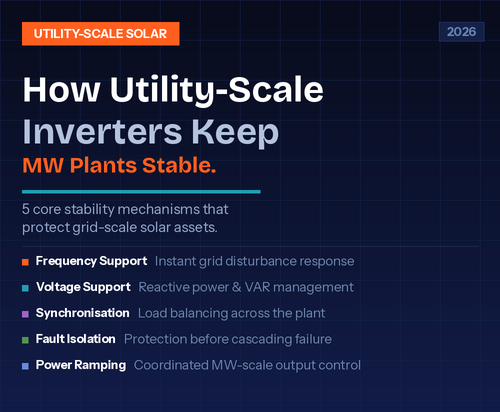
How Utility Scale Inverters Maintain Stability: The Core Mechanisms
Mechanism 1: Instant Frequency Support
How It Works: Inverter constantly monitors grid frequency (50 Hz target). When frequency drops below 49.8 Hz, inverter detects this disturbance and instantly increases power output within 100-200ms. This power injection slows the rate of frequency decline, preventing complete collapse.
Real Impact: During a grid disturbance, a 50 MW plant can inject an extra 5-10 MW for several seconds. This additional power, multiplied across dozens of plants, prevents frequency from collapsing below safe limits and prevents cascading blackouts.
Why It Matters: Solaire's X3 GRAND utility-scale inverters include integrated frequency support as a core function. Without it, grid operators must reject new solar or force existing plants offline during disturbances. With it, plants actively prevent blackouts across the region.
Mechanism 2: Voltage Support Through Reactive Power
How It Works: Grid voltage fluctuates based on power flow and load changes. During disturbances, voltage can sag to 80-85% of nominal (dangerous for motors and transformers). Inverter detects voltage sag and injects reactive power to restore voltage back to safe levels (90-110%).
Voltage Ride-Through: Modern grid codes mandate that plants stay connected during voltage sags of ±30% for ≥1 second. Inverters achieve this by remaining synchronized to the grid during the sag, supplying reactive current to support recovery, and continuing normal operation after stabilization.
Why It Matters: Without ride-through capability, plants disconnect during grid disturbances – making the situation worse. Solaire's inverters with full ride-through capability actively participate in grid recovery, supporting voltage stability across the region.
Mechanism 3: Synchronization and Load Balancing
How It Works: A 50 MW plant uses 50-100 utility scale inverters operating in parallel. Each must generate exactly 50 Hz synchronized to the grid, match the phase angle of grid voltage, and share current equally with other inverters. If one inverter drifts out of synchronization, circulating currents develop and system becomes unstable.
Inverters maintain synchronization through Phase-Locked Loop (PLL) circuits that continuously measure grid voltage phase and adjust inverter output in real-time to match. Automatic current sharing between parallel units ensures no single inverter is overloaded.
Why It Matters: Without precise synchronization, inverter failures cascade across the plant. Solaire's multi-unit architecture with PLL synchronization ensures if one inverter fails, others smoothly rebalance load without system instability or generation loss.
Mechanism 4: Fault Isolation and Protection
How It Works: A ground fault on one solar string can generate dangerous arc currents. Without proper isolation, arc current spreads to adjacent strings, multiple strings fail simultaneously, and entire plant shuts down. Inverters prevent cascade failures through string-level fusing (single string fault doesn't affect others), arc fault detection (detects dangerous arcing and isolates within 50-100ms), and surge protection with Type II SPD devices rated 10-15 kA.
Why It Matters: With isolation, a single string fault removes ~0.5% of plant capacity. Without it, single fault cascades to 100% shutdown. This difference is ₹50+ lakhs daily in lost generation. Solaire inverters include integrated AFCI and Type II protection as standard, preventing cascade failures.
Mechanism 5: Coordinated Power Ramping
How It Works: Grid operators need plants to adjust output in controlled manner. Uncontrolled ramp rates destabilize frequency. Inverters solve this by accepting output setpoint commands from grid operators and smoothly ramping power up/down (typically max 10% per minute) with real-time feedback on actual output vs. commanded output.
Why It Matters: With coordinated ramping, 50+ MW plants across a region collectively match demand without destabilizing frequency. Solaire's SCADA integration and advanced control algorithms enable seamless grid operator coordination, making solar the most controllable renewable resource.
Real-World Impact: Why This Matters
For Grid Operators: Plants with stability functions can operate reliably at 15-20% of total grid capacity. Without them, solar penetration must be capped at 5-10% to maintain stability.
For Plant Owners: Stability capability determines PPA compliance. PPAs now include clauses requiring frequency support response within 100ms, reactive power injection on demand, and voltage ride-through during faults. Non-compliance = ₹5-10 crore annual penalties on a 50 MW plant.
For the Grid: Solar plants become grid-supporting infrastructure, not just power sources. They actively prevent blackouts instead of destabilizing the grid during cloud transients.
Related Articles
FAQs About Utility Scale Solar Inverters
How fast do utility inverters respond to grid disturbances?
What is reactive power and why does it matter?
What happens if a utility scale inverter fails in a 50 MW plant?
How do SLDC regulations affect utility scale inverter selection?
Can utility scale solar inverters operate during grid blackouts?
Conclusion: Stability Through Electronic Control
Utility scale solar inverters maintain MW-scale plant stability through simultaneous management of frequency support, voltage stabilization, precise synchronization, fault isolation, and coordinated power ramping. Without these functions, 50 MW of solar generation would destabilize the grid. With them, solar becomes the most grid-friendly renewable technology available. For corporations deploying 50+ MW installations, inverter capability determines not just energy generation, but grid reliability for the entire region.